

Yakirevich, A., Coffin, A., Widmer, J., Pisani, O., Hill, R., & Pachepsky, Y. (2026). Modeling E. coli fate and transport in and around a cattle pond. Hydrology and Earth System Sciences, 30(12), 3805–3823. https://doi.org/10.5194/hess-30-3805-2026
“Accounting for the complexity of hydrogeological and hydrochemical processes, we choose the HGS (Therrien et al., 2010) as a basis for the model. In HGS, the flow of water is simulated in a fully integrated mode; water derived from rainfall inputs is partitioned into components such as overland and stream flow, evaporation, infiltration, recharge, and subsurface discharge into surface water features such as lakes, streams, and wetlands in a natural, physics-based fashion. It employs a fully coupled numerical approach, allowing the simultaneous solution of both the surface and variably saturated subsurface flow, solute transport, and heat transfer.”
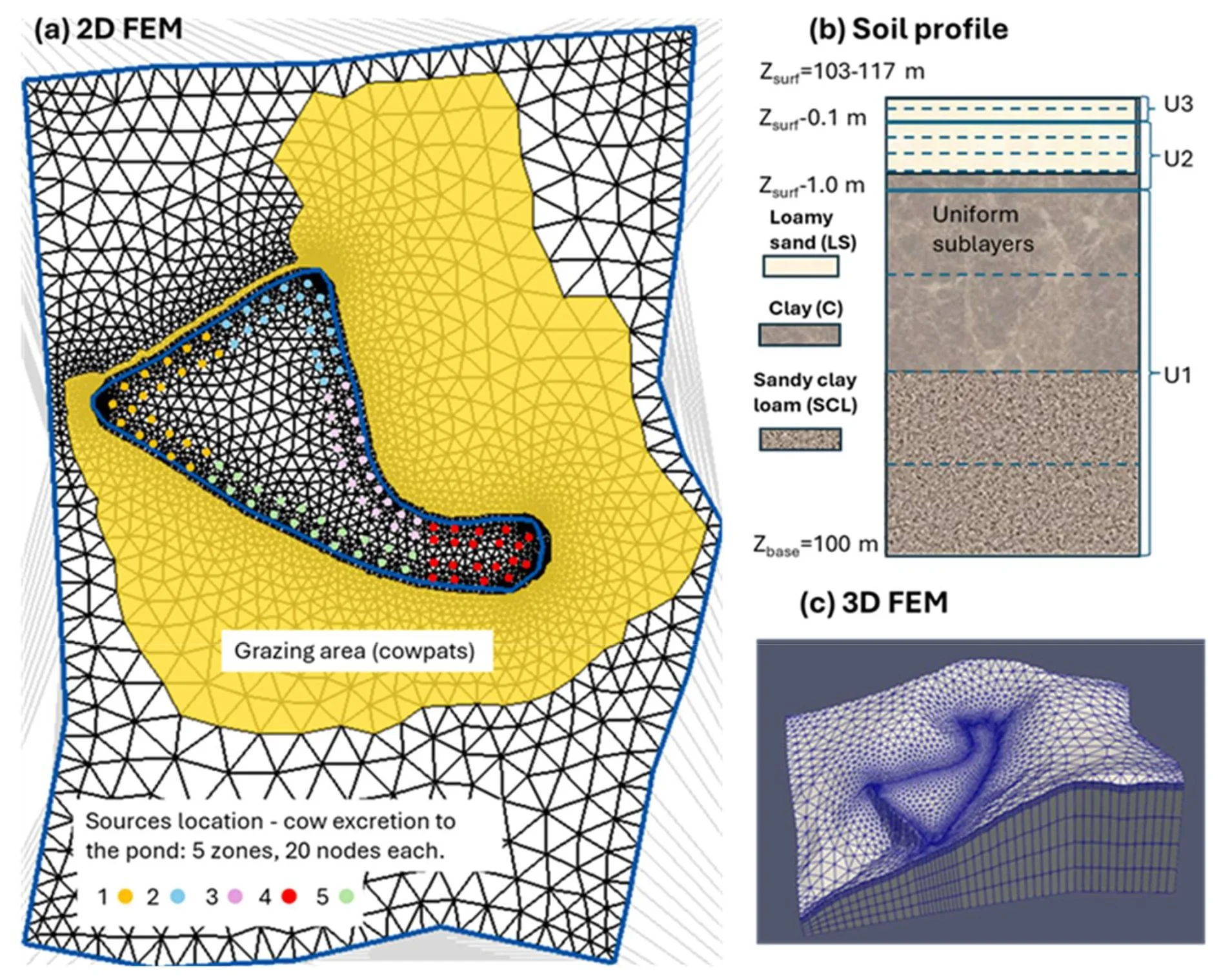
Fig 3. Numerical model setup: (a) The 2D triangular finite element mesh in the simulation domain. Cowpats (a flat, round piece of cow dung) are located in the yellow color area. Colored circles represent the location of sources to simulate cattle excretion in the pond. (b) Schematic representation of numerical mesh layers in the simulated profile. Solid and dashed horizontal lines represent the boundaries between layers and sublayers, respectively. (c) 3D finite element mesh (FEM).
We're pleased to highlight this publication by Alexander Yakirevich and colleagues, which explores the fate and transport of Escherichia coli (E. coli) in and around a cattle pond using HydroGeoSphere (HGS). The study presents a fully integrated surface water–groundwater model that simulates the hydrology of a small watershed (~0.45 km²) alongside microbial transport, providing new insight into how livestock activities influence water quality in agricultural watersheds.
Understanding how microbial contaminants move through agricultural watersheds is essential for protecting water resources used for livestock, irrigation, recreation, and downstream ecosystems. While runoff from grazing lands is widely recognized as a source of bacterial contamination, the relative importance of different transport pathways—including overland flow, subsurface flow, and direct livestock deposition into ponds—has remained difficult to quantify. Traditional monitoring alone cannot capture these complex interactions, highlighting the need for integrated physics-based modelling approaches.
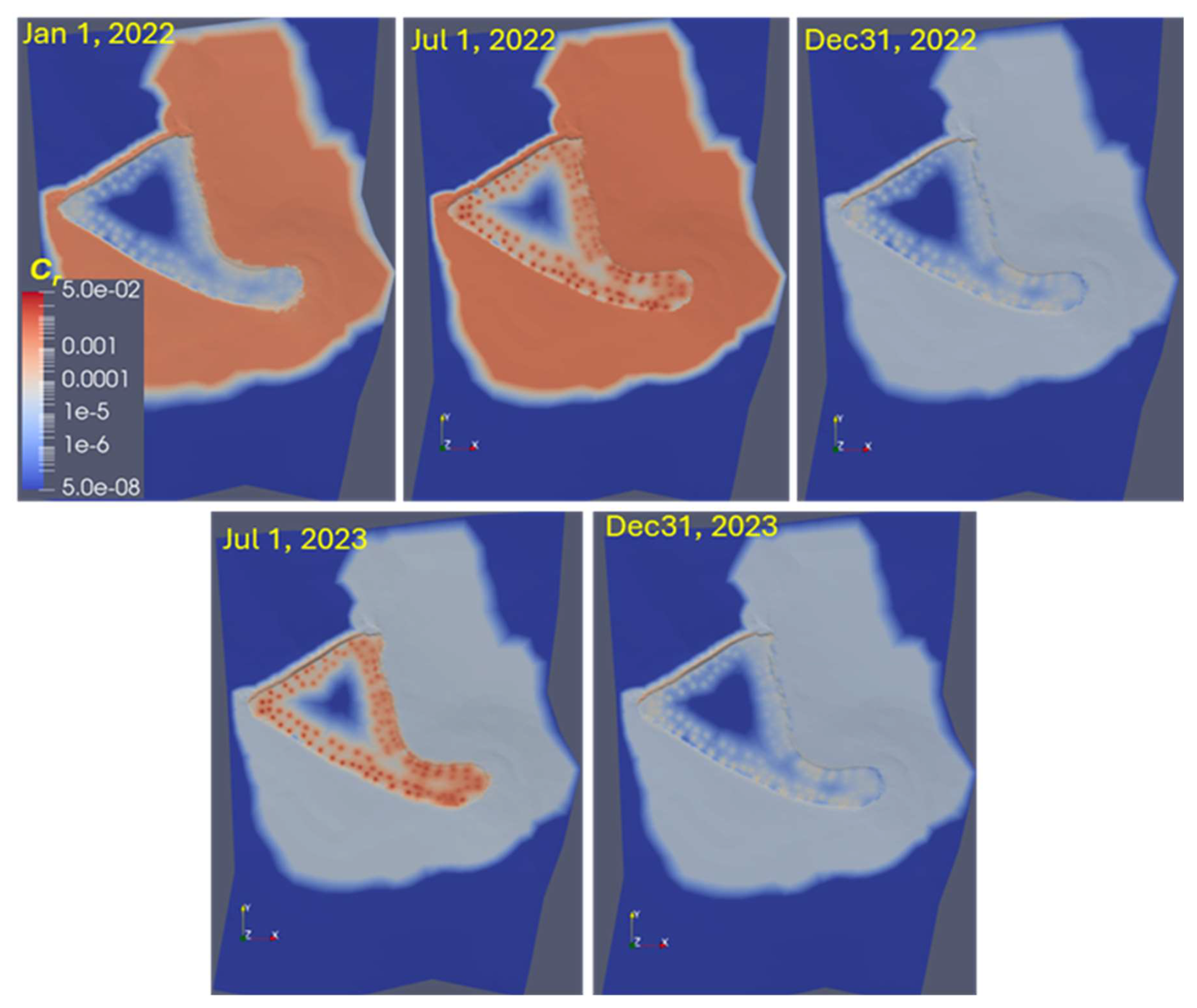
Fig 11. Simulated spatiotemporal distribution of the relative E. coli concentration at the surface. Cr = C/Cmax, Cmax = 1.4×10^10 MPN m−3, the legend is on a log scale.
To address these challenges, the researchers developed a fully integrated HydroGeoSphere (HGS) model of a 0.45 km² cattle-grazing watershed in Georgia, USA. The model coupled three-dimensional variably saturated groundwater flow with two-dimensional surface water flow and simulated E. coli transport using coupled advection-dispersion equations that account for bacterial release from cowpats, sorption, and temperature-dependent inactivation. Field observations collected over multiple years—including weather data, pond water sampling, manure sampling, and automated trail camera imagery tracking cattle activity—were incorporated to realistically represent bacterial loading from both grazing areas and cattle entering the pond.
The simulations successfully reproduced the overall spatial and temporal patterns of E. coli concentrations throughout the pond without requiring extensive model calibration. The most significant finding was that direct deposition of manure by cattle standing in the pond contributed approximately two orders of magnitude more E. coli than surface runoff from surrounding grazing lands. The study also demonstrated how seasonal weather conditions, bacterial die-off rates, and livestock behaviour influence microbial concentrations, while highlighting additional factors—such as waterfowl activity and pond mixing—that may explain observed concentration spikes not captured by the model.
HydroGeoSphere was central to this work because it enabled the researchers to simulate the complete hydrologic system within a single, fully coupled modelling framework. By integrating surface water flow, variably saturated subsurface flow, microbial transport, evapotranspiration, and dynamic bacterial loading from livestock, HGS provided a process-based understanding of how microbial contamination develops and moves throughout the watershed. This level of integration allowed the researchers to distinguish between competing contamination pathways and evaluate their relative importance under real-world conditions.
This work demonstrates how integrated hydrologic modelling can improve our understanding of microbial water quality in agricultural watersheds. By combining field observations with HydroGeoSphere's advanced surface water–groundwater modelling capabilities, the researchers developed a practical framework for predicting E. coli contamination using readily available data. The findings provide valuable guidance for consultants, watershed managers, and agricultural professionals seeking to identify the primary sources of microbial contamination and develop more effective water quality management strategies.
Interested in seeing how this research evolved? Before the full journal publication, the team presented this work as a conference poster highlighting the development of the HydroGeoSphere model and the early findings. Read our previous research highlight on the poster by clicking the link below.
Abstract:
Contamination of surface water is a concern for public health. Lands used for animal production are sources of fecal microorganisms that can reach water bodies, impact their quality, and adversely affect their potential uses. Understanding the mechanisms of microbial transport through surface/subsurface flow is imperative to predict surface water contamination and to assign management strategies for enhanced water quality. The aim of this work was to develop and test a mechanistic numerical model to simulate watershed-scale surface/subsurface water flow, bacteria release from cow manure, and their fate, as well as transport to a cattle pond. The integrated surface-subsurface hydrological platform HydroGeoSphere (HGS) was the basis for the site-specific model. The pond and its environs were monitored for 15 months for Escherichia coli (E. coli) concentrations, which remained relatively high throughout the study. The model was applied to simulate E. coli bacteria transport in a grassed drainage basin grazed by a permanent herd of approximately 50 cattle. Most model parameter values were adopted from the literature. The model explicitly accounted for cow excretion to the pond as a source of microbial contamination. The latter was estimated from the time spent by cows in the pond, which in turn was estimated from imagery obtained with eight trail cameras installed to cover the pond surface. Images were obtained every 15 min. Simulations for two years showed that the non-calibrated model replicated spatiotemporal patterns and peak E. coli concentration reasonably well. The E. coli cumulative flux loaded by cattle excretion directly to the pond was around two orders of magnitude greater than that with the surface flow. The results demonstrate that mechanistic watershed-scale modeling combined with observational data on cattle behavior can provide useful predictions of microbial contamination in cattle ponds using only readily available data.