
HGS RESEARCH HIGHLIGHT – Hybrid deep learning-numerical modeling framework for long-term prediction of groundwater discharge and radionuclide transport

Seong, M., Kim, H. G., Yun, B., Kim, M., Kim, J.-W., Jeong, H., Kim, S., Kim, J. H., & Cho, K. H. (2026). Hybrid deep learning-numerical modeling framework for long-term prediction of groundwater discharge and radionuclide transport. Journal of Hazardous Materials, 504, 141346. https://doi.org/10.1016/j.jhazmat.2026.141346
“The model was trained to predict monthly groundwater discharge (GWD) and radionuclide transport (RNT), and its performance was evaluated against the results from HGS, which serves as a physically rigorous reference model.”
“Because real-world data for the hypothetical ADioS watershed were unavailable, the HGS model, which is a fully distributed, physically based, integrated surface–subsurface hydrological model, was used to simulate groundwater flow and radionuclide transport for target feature extraction.”
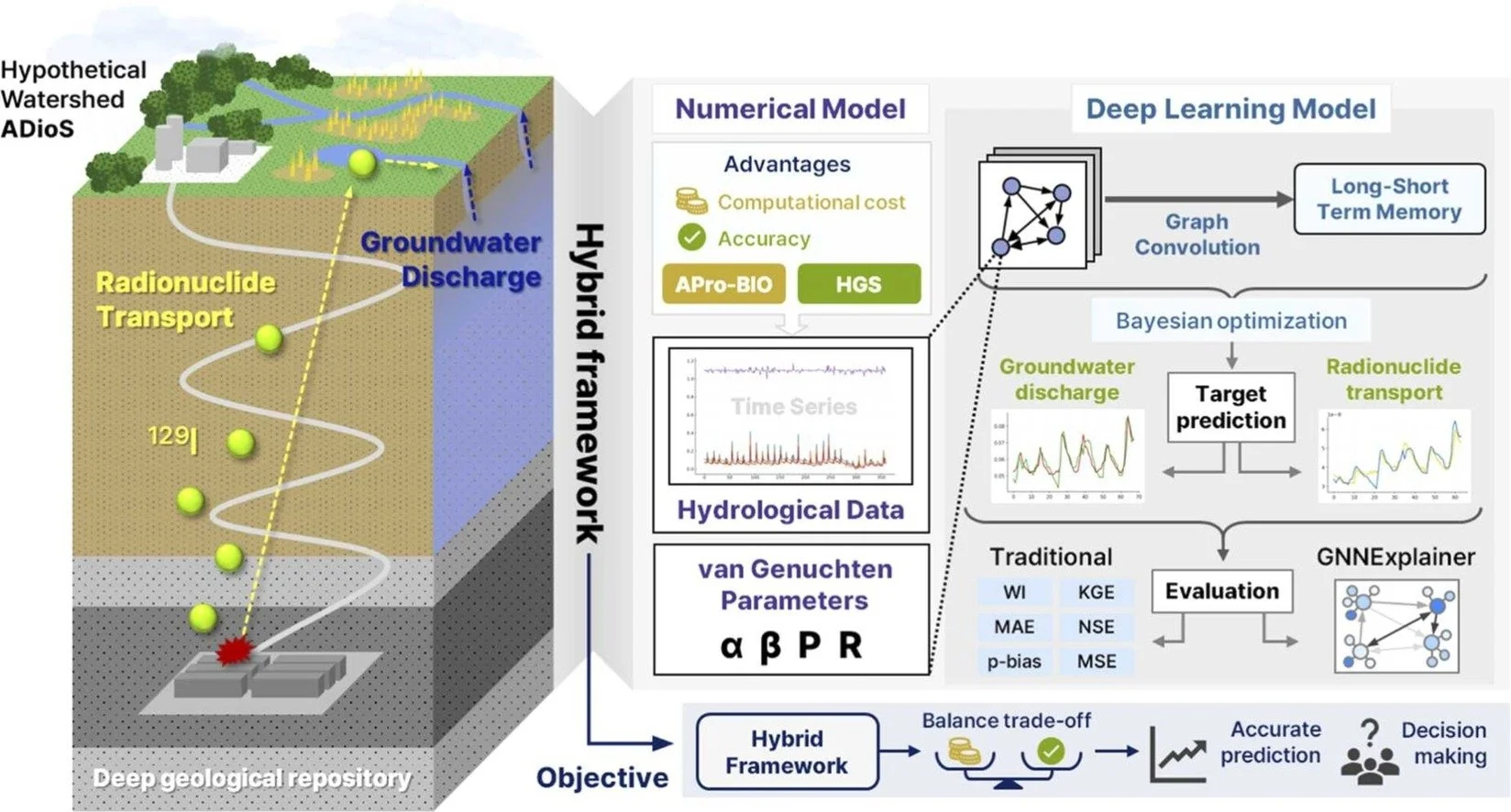
Graphical Abstract
We're pleased to highlight this publication by Minkyeong Seong and colleagues, which presents a hybrid deep learning–numerical modelling framework for improving long-term predictions of groundwater discharge and radionuclide transport. Using HydroGeoSphere (HGS) as the physics-based reference model, the researchers combined process-based numerical modelling with a graph convolutional long short-term memory (GC-LSTM) deep learning model to produce long-term predictions while dramatically reducing computational costs.
Long-term prediction of groundwater flow and radionuclide transport is essential for evaluating the safety of deep geological repositories used to store radioactive waste. While fully integrated numerical models such as HydroGeoSphere provide highly accurate simulations of coupled surface water, groundwater, and contaminant transport processes, these simulations can become computationally demanding for assessments spanning decades, centuries, millenia or even millions of years. Simpler models offer faster runtimes but often sacrifice accuracy by neglecting important processes such as unsaturated flow. This study addresses that challenge by combining the strengths of physics-based modelling with artificial intelligence to improve both efficiency and predictive performance.
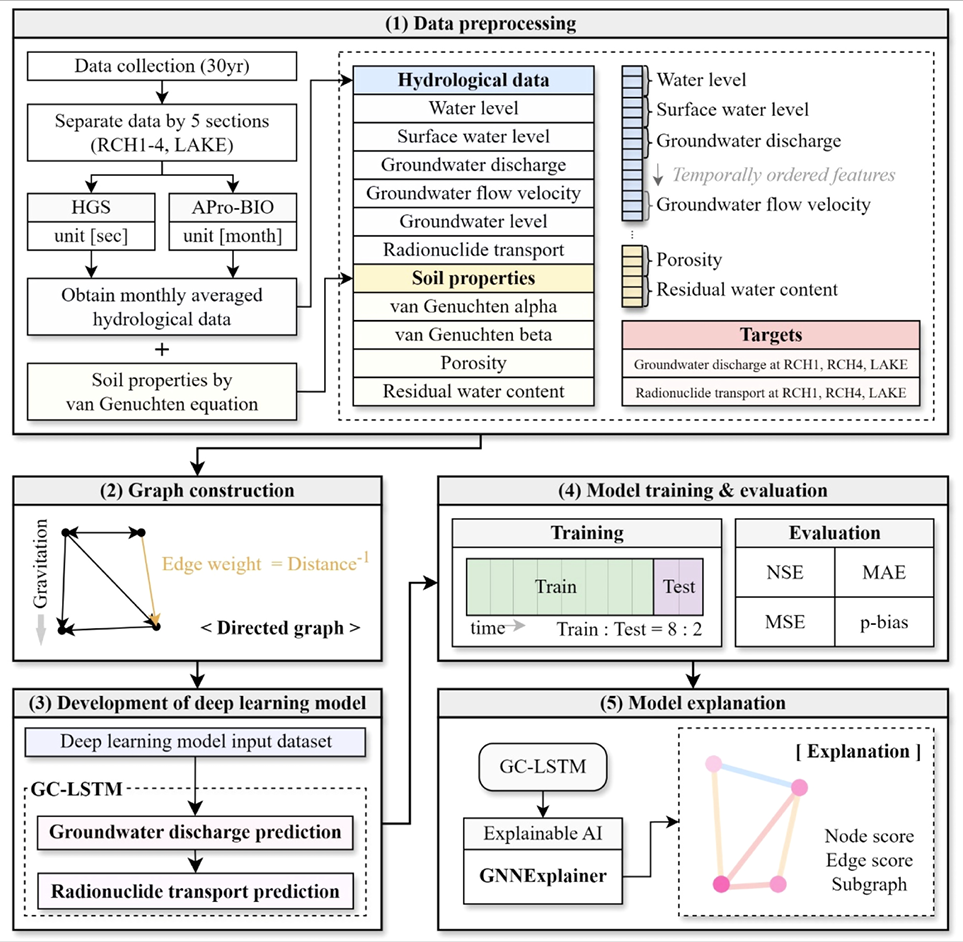
Fig 1. Overview of the hybrid modeling framework: (1) data preprocessing from two numerical models: adaptive process-based total system performance assessment framework (APro-BIO) and HydroGeoSphere (HGS); (2) graph construction for the graph construction for the graph convolutional long short-term memory (GC-LSTM) model; (3) model development for predicting groundwater discharge (GWD) and radionuclide transport (RNT); (4) model training and eval uation; and (5) model interpretation using GNNExplainer.
The researchers developed a hybrid modelling framework using outputs from the Adaptive Process-Based Total System Performance Assessment Framework (APro-BIO), together with HydroGeoSphere simulations, to train a graph convolutional long short-term memory (GC-LSTM) model. HydroGeoSphere served as the benchmark model by generating groundwater discharge and radionuclide transport data that the deep learning model learned to reproduce. By incorporating hydrologic variables alongside key unsaturated soil properties, including van Genuchten parameters, the GC-LSTM captured the complex spatial and temporal interactions governing groundwater flow and contaminant transport throughout a hypothetical watershed representing a deep geological disposal system.
The hybrid framework demonstrated strong predictive performance, achieving Kling-Gupta Efficiency (KGE) values ranging from 0.67–0.85 for groundwater discharge and 0.60–0.81 for radionuclide transport. Compared to the simplified APro-BIO model, the GC-LSTM reduced discrepancies with HydroGeoSphere by up to 99%, closely reproducing both the timing and magnitude of groundwater discharge and radionuclide transport across the watershed. Once trained, the deep learning model generated predictions in less than one minute, providing more than a 3,000-fold improvement in inference speed compared to running new HydroGeoSphere simulations while maintaining excellent agreement with the physics-based model.
HydroGeoSphere played a central role in this research by providing the physically rigorous benchmark required to train and validate the hybrid modelling framework. Its fully integrated simulation of saturated and unsaturated groundwater flow, surface water interactions, and radionuclide transport enabled the researchers to accurately represent complex hydrologic processes that simplified models cannot capture. HydroGeoSphere also demonstrated the importance of unsaturated zone processes, showing that accounting for soil hydraulic properties significantly improves predictions of groundwater recharge, groundwater discharge, and radionuclide migration.
This research demonstrates how HydroGeoSphere can serve as the foundation for next-generation hybrid modelling approaches that combine physics-based simulations with artificial intelligence. By leveraging HGS to generate high-quality training data, the researchers developed a framework capable of maintaining the accuracy of fully integrated hydrologic modelling while dramatically reducing computational costs. The approach offers significant potential for long-term groundwater safety assessments, radionuclide transport studies, and other computationally intensive environmental modelling applications where both speed and reliability are essential.
Abstract:
Accurate long-term prediction of groundwater flow and radionuclide transport is critical for assessing the safety of deep geological disposal systems. This study proposes a hybrid modeling framework that integrates a numerical model with a deep learning approach to improve the predictive accuracy and computational efficiency. Outputs from the adaptive process-based total system performance assessment framework (APro-BIO) model, including water level, surface water flow, groundwater recharge, groundwater discharge (GWD), groundwater flow velocity, groundwater level, and radionuclide transport (RNT), together with van Genuchten parameters, were used as input features. Monthly groundwater discharge and radionuclide transport simulated by HydroGeoSphere (HGS) served as target variables, and a graph convolutional long short-term memory (GC-LSTM) model was trained to capture spatial and temporal dependencies. Model performance was evaluated against that of HGS, representing coupled saturated–unsaturated flow. The GC-LSTM achieved Kling–Gupta Efficiency values of 0.67–0.85 for GWD and 0.60–0.81 for RNT and reduced discrepancies relative to that of APro-BIO by up to 99 %. The model effectively reproduced temporal variability while reducing computational cost. Explainable AI analysis identified the van Genuchten β parameter as the most influential feature. These results demonstrate that the proposed framework provides an efficient and reliable alternative for long-term GWD and RNT prediction under computational constraints.