

Note: all event times are in eastern (EST/EDT)
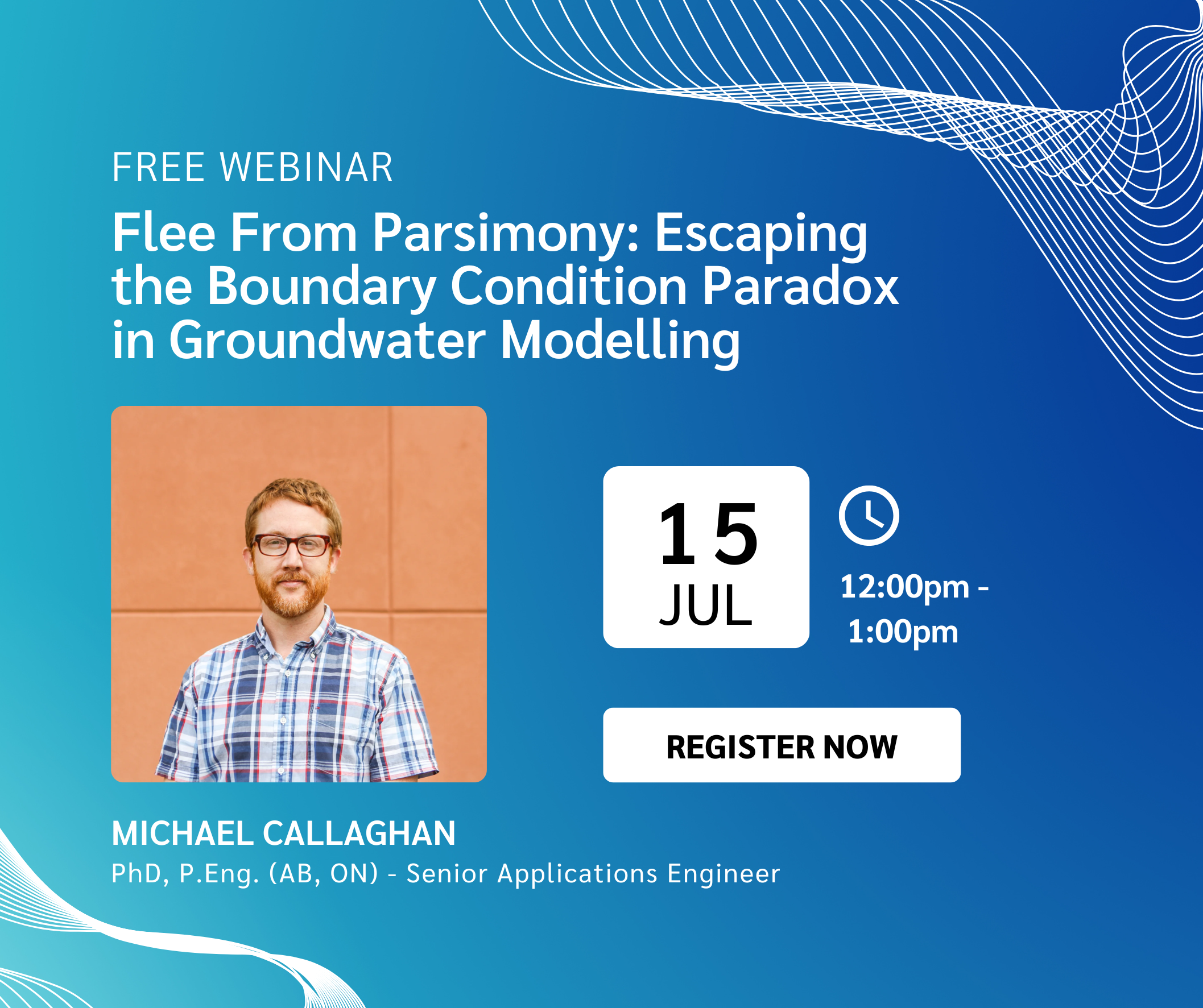
Join us for an engaging presentation, Flee From Parsimony: Escaping the Boundary Condition Paradox in Groundwater Modelling, examining how integrated hydrologic modelling approaches can address the growing complexity of groundwater management challenges.
Presentation Title: Flee From Parsimony: Escaping the Boundary Condition Paradox in Groundwater Modelling
Abstract:
Questions being posed of hydrologic models by clients, governments and regulators are becoming broader ranging and more complex, for example, how will the model results be affected by climate change; what are the cumulative regional effects on groundwater resources; how will water quality be affected; and, what are the effects on surface water-groundwater (SW-GW) interaction?
Groundwater models typically have recharge zones prescribed by the modeller, with surface water features delineated with specified boundary conditions. The location and timing of recharge is highly variable, and specifying the location and magnitude of recharge is to some degree assuming a model input that should be a model output, and that is the boundary condition paradox. In a climate change assessment, if recharge is prescribed, how do you propagate changing precipitation patterns, shifting evapotranspiration, and altered snowmelt timing through the model? Cumulative regional effects require spatial scales and process interactions that simple recharge zones sub-divide somewhat arbitrarily. Contaminant transport is sensitive to where and how fast recharge actually occurs, not where it might be assumed to occur. Dynamic SW-GW interaction zones are precisely where prescribed boundary conditions are most likely to be wrong and most consequential.
Integrated surface-subsurface hydrological modelling with HydroGeoSphere (HGS) is essentially the antithesis of the parsimonious recharge-zone approach. By fully coupling surface water and groundwater in a physically based, variably saturated model, HGS avoids the boundary condition paradox by construction. Recharge is an output from the simulation of precipitation, evapotranspiration, overland flow, and unsaturated zone flow dynamics. In a world where municipalities, mining companies, oil and gas operators, agricultural operations, and regulators are asking questions that a simple recharge zone model structurally cannot answer, perhaps the classical tools are now mismatched to the questions being asked.
Presenter Bio:
Dr. Michael Callaghan is a Senior Applications Engineer at Aquanty Inc. He received his Ph.D. (2014) in (Environmental) Geoscience at the University of Calgary, his M.Sc. (2003) in Hydroinformatics and Hydraulic Engineering at Newcastle University in the U.K., and his B.A.Sc. (1999) in Geological Engineering at the University of British Columbia. Mike has over 25 years experience in the geoenvironmental sector, including over 20 years of numerical modelling experience ranging from soil column scale to large river basin scale, spanning diverse applications such as river sedimentation modelling, salt and pesticide leaching to environmental receptors, hydrologic risk assessment for agriculture, regulatory permitting for mine development, and more recently, integrated hydrologic modelling for groundwater supply. Mike has worked nationally and internationally, with extended field positions in Greece and Cuba.
His research at Aquanty has focused on hydrological modeling of flood and drought in the Canadian Prairies for agricultural risk assessment and partitioning of water balance components for development of the Athabasca Oil Sands in the Boreal Plains. Past research activities have included: characterization and modeling of water flow and solute transport in soil in the presenceof preferential flow pathways, such as macropores and fractures; the effects of physical and chemical processes on soil hydraulic conductivity; and, advanced techniques for pore network characterization.
Use The Form Below To Register
Register for this webinar to explore how integrated surface–subsurface hydrologic modelling helps address the boundary condition paradox in groundwater modelling. This session highlights how HydroGeoSphere simulates recharge as a dynamic model output—supporting more reliable assessments of climate change impacts, surface water–groundwater interactions, and regional groundwater systems.