

Note: all event times are in eastern (EST/EDT)
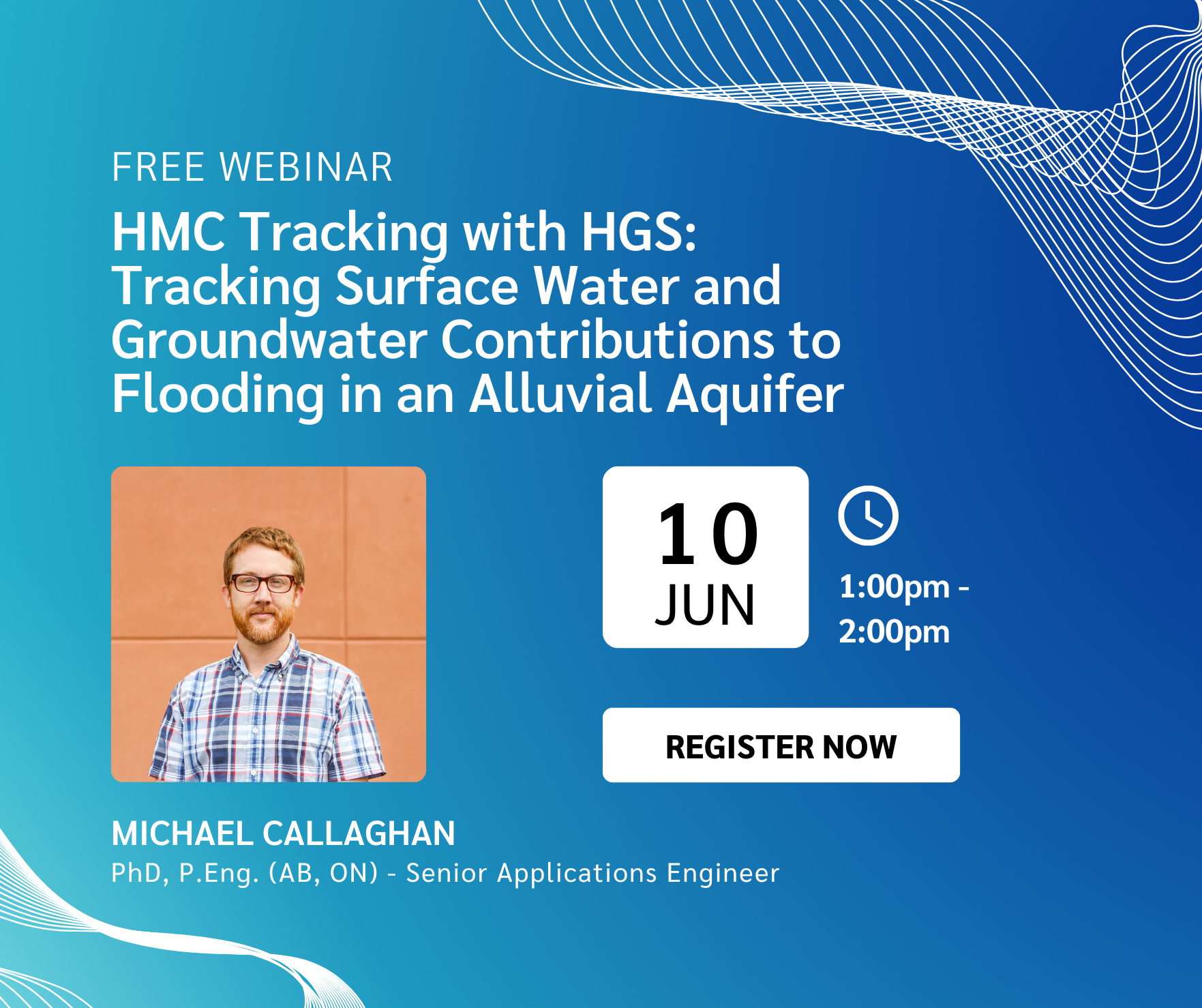
Join us for an insightful presentation exploring how integrated hydrologic modelling can improve understanding of groundwater flooding risks in alluvial aquifer systems— particularly during major flood events.
Presentation Title: Tracking surface water and groundwater contributions to flooding in an alluvial aquifer.
Abstract:
There is an increasing recognition that in certain cases groundwater flooding can be an important cause of damage to infrastructure during flood events. Groundwater flow in coarse alluvial deposits can bypass overland flood defences and result in the inundation of subsurface structures (i.e., basements), without the water table reaching the surface. During the widespread flooding across southeastern Alberta in June 2013, groundwater flooding was implicated as an early flood mechanism in urban environments adjacent to streams and rivers. Groundwater flooding can have a strong component of surface water-groundwater (SW-GW) interaction well suited to simulation by integrated hydrological models, such as HydroGeoSphere (HGS). By accounting for both surface water and groundwater processes, better quantification of the risk of groundwater flooding is enabled. A relatively new technology implemented in HGS for investigating SW-GW interactions is the Hydraulic Mixing Cell (HMC) approach. The HMC method tracks the fraction of different water sources in space and time providing a quantitative measure of those sources at any point downstream. The utility of the HMC approach has been demonstrated for tracking hyporheic exchange in alluvial channels, calculating groundwater contributions to streamflow, and identifying sources of streamflow. Here we apply the HMC approach to track components of surface water and groundwater during the passage of the June 2013 fluvial flood wave through the Town of High River. The HMC results give insight into the transient nature of the passing of the flood wave and SW-GW interactions that may have implications for the design of flood defences.
Presenter Bio:
Dr. Michael Callaghan is a Senior Applications Engineer at Aquanty Inc. He received his Ph.D. (2014) in (Environmental) Geoscience at the University of Calgary, his M.Sc. (2003) in Hydroinformatics and Hydraulic Engineering at Newcastle University in the U.K., and his B.A.Sc. (1999) in Geological Engineering at the University of British Columbia. Mike has over 25 years experience in the geoenvironmental sector, including over 20 years of numerical modelling experience ranging from soil column scale to large river basin scale, spanning diverse applications such as river sedimentation modelling, salt and pesticide leaching to environmental receptors, hydrologic risk assessment for agriculture, regulatory permitting for mine development, and more recently, integrated hydrologic modelling for groundwater supply. Mike has worked nationally and internationally, with extended field positions in Greece and Cuba.
His research at Aquanty has focused on hydrological modeling of flood and drought in the Canadian Prairies for agricultural risk assessment and partitioning of water balance components for development of the Athabasca Oil Sands in the Boreal Plains. Past research activities have included: characterization and modeling of water flow and solute transport in soil in the presenceof preferential flow pathways, such as macropores and fractures; the effects of physical and chemical processes on soil hydraulic conductivity; and, advanced techniques for pore network characterization.
Use The Form Below To Register
Register for this webinar to learn how integrated hydrologic modelling can improve understanding of groundwater flooding risks in alluvial aquifer systems during major flood events. This session highlights how HydroGeoSphere’s Hydraulic Mixing Cell (HMC) approach helps track surface water–groundwater contributions to support better flood-risk assessment.