

Note: all event times are in eastern (EST/EDT)
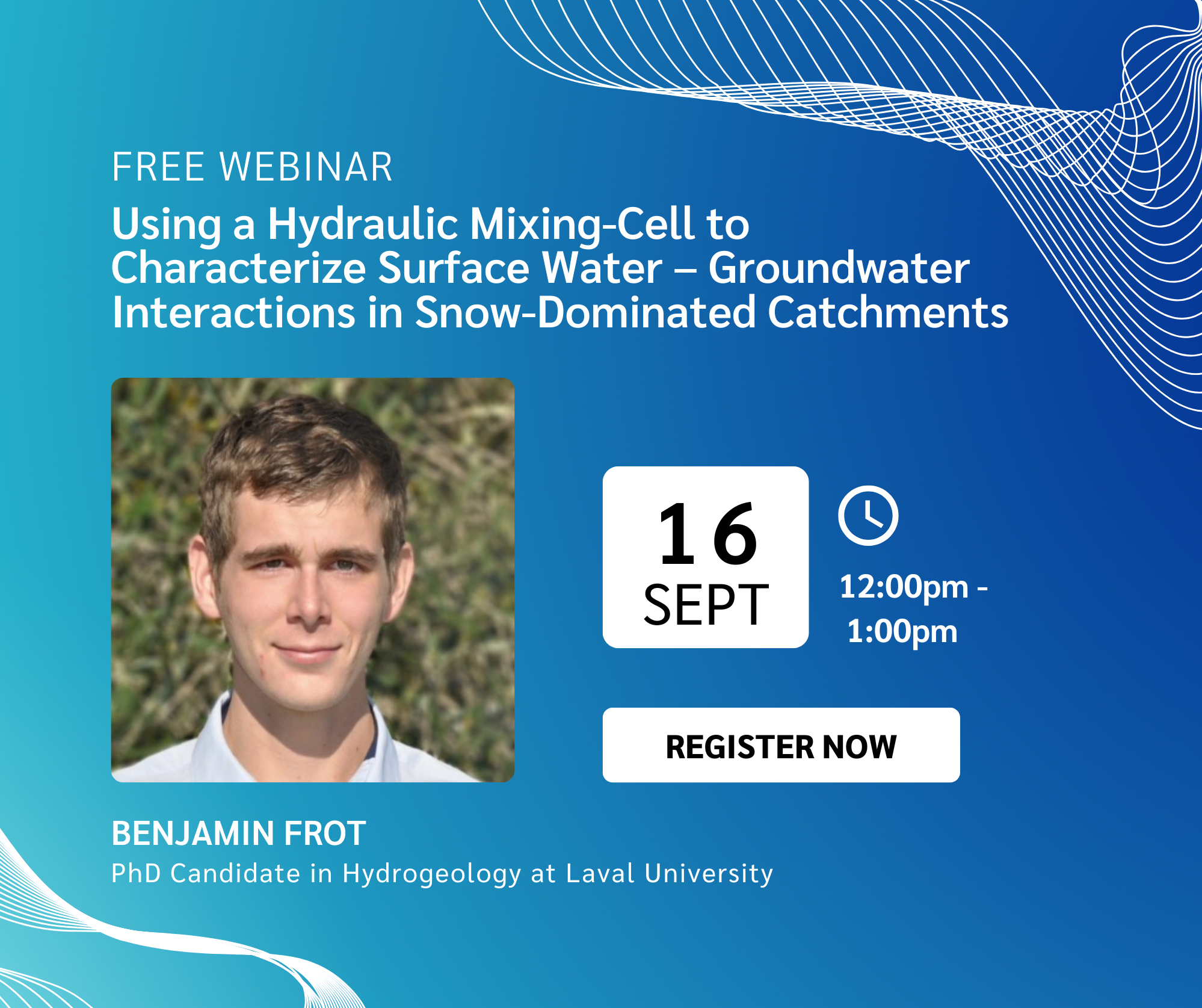
Join us for an engaging presentation, Using a Hydraulic Mixing‑Cell to Characterize Surface Water – Groundwater Interactions in Snow‑Dominated Catchments, exploring how integrated hydrologic modelling and innovative post-processing techniques can improve our understanding of groundwater contributions to streamflow, water age and climate change impacts in snow-dominated watersheds.
Presentation Title: Using a Hydraulic Mixing‑Cell to Characterize Surface Water – Groundwater Interactions in Snow‑Dominated Catchments
Abstract:
Quebec City’s main drinking water intake is supplied by the 350 km² catchment that feeds the Saint-Charles River. During intensive low flow periods, up to 95% of the river discharge is pumped and a strong understanding of surface water – groundwater interactions is essential to evaluate transient water availability. A fully integrated 3D surface-subsurface flow model of the catchment was developed using the HydroGeoSphere platform to evaluate current and project future transient water availability. The model was calibrated using time series of groundwater levels and stream discharges collected from 30 monitoring wells and 14 gauging stations distributed across the catchment. This integrated approach provides a detailed representation of the water cycle and the contribution of groundwater to streamflow. A hydraulic mixing-cell (HMC) postprocessing tool was then applied to quantify the fractions of different streamflow components. A modified HMC was also used to estimate water age which enabled the development of innovative vulnerability indices. The results revealed a strong predominance of groundwater at the drinking water intake and an average age of four years. These findings are consistent with isotopic analyses. To further test the robustness of the methodology, the HMC method was subsequently applied to the numerical model of the 1 km² sub-catchment 7A of the Bassin Expérimental du Ruisseau des Eaux Volées (BEREV). Climate-change scenarios were incorporated, allowing us to highlight the potential impacts of climate warming in regions where hydrological dynamics are strongly controlled by spring snowmelt.
Presenter Bio:
Benjamin Frot is a PhD candidate in hydrogeology at Laval University, supervised by Professor René Therrien. He studied in France, where he obtained an engineering degree in geosciences, specialising progressively in the sustainable management of water resources. He worked in Geneva (Switzerland) on hydrogeothermal modelling before starting his PhD in Quebec City (Canada). His PhD project focuses on studying the vulnerability of Quebec City’s drinking water source through hydrological modelling using HydroGeoSphere. He is interested in surface water – groundwater interactions and the impacts of climate change on water resource availability.
Use The Form Below To Register
Register for this webinar to learn how integrated hydrologic modelling and the Hydraulic Mixing-Cell (HMC) approach can improve understanding of surface water–groundwater interactions in snow-dominated catchments. This session explores groundwater contributions to streamflow, water age, and the potential impacts of climate change on water availability.