
HGS RESEARCH HIGHLIGHT – Diffusion-Controlled Solute and Isotope Transport in the Milk River Aquifer System, Alberta, Canada: Implications for Dating Old Groundwater

Musy, S. L., Purtschert, R., Sturchio, N. C., Heraty, L. J., Mueller, P., Lantis, J., Bishof, M. N., Vockenhuber, C., Date, A., Mayer, B., & Yokochi, R. (2026). Diffusion-Controlled Solute and Isotope Transport in the Milk River Aquifer System, Alberta, Canada: Implications for Dating Old Groundwater. ACS Earth and Space Chemistry, 10(5), 1291–1309. https://doi.org/10.1021/acsearthspacechem.5c00397
“Numerical simulations implemented in HydroGeoSphere explicitly represent advection, dispersion, diffusion, and radioactive decay, and explore parameter uncertainty through Monte Carlo analyses. Comparison of observed and simulated tracer–tracer and tracer–distance relationships allows us to quantify diffusion-induced dilution of ³⁶Cl, evaluate the potential bias in ⁸¹Kr-derived residence times, and delineate the conditions under which each tracer yields robust age information. This combined observational–modeling framework enables us to (i) quantify diffusion-controlled solute exchange, (ii) reassess long-standing interpretations of ³⁶Cl systematics in the Milk River Aquifer, and (iii) evaluate the robustness of ⁸¹Kr as a chronometer for very old groundwater in regional aquifers affected by long-term diffusive exchange.”
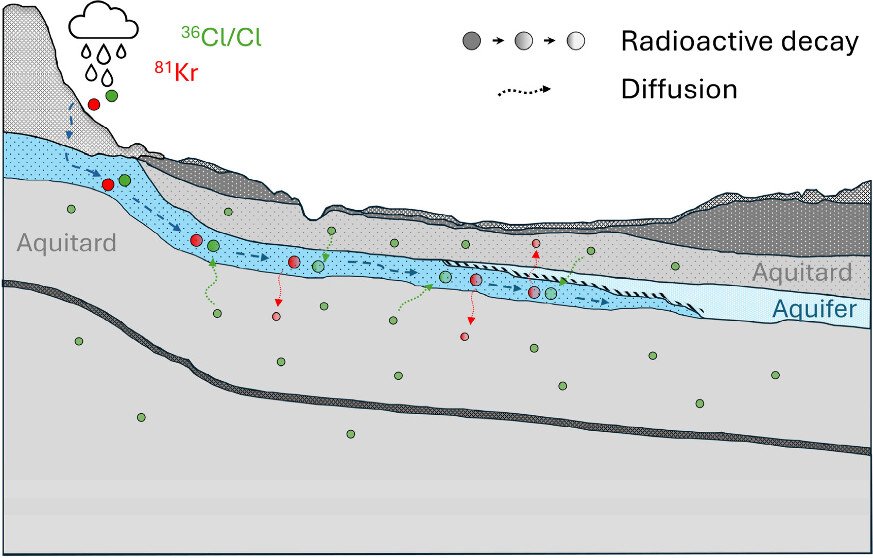
Abstract Image.
We’re pleased to highlight this recent publication by Stephanie L. Musy and colleagues, which investigates how diffusion-controlled solute transport influences groundwater age interpretations in the Milk River Aquifer (MRA), a transboundary aquifer system spanning southern Alberta and northern Montana. The study combines multiple environmental tracers, including krypton-81 (⁸¹Kr), chlorine-36 (³⁶Cl), stable chlorine isotopes (³⁷Cl/³⁵Cl), and radiocarbon (¹⁴C), with HydroGeoSphere (HGS) simulations to better understand groundwater residence times and the processes controlling tracer distributions in old groundwater systems.
Determining the age of fossil groundwater is critical for managing non-renewable groundwater resources, particularly in semi-arid regions where recharge rates are low and groundwater withdrawals often exceed replenishment. Historically, groundwater age estimates in the Milk River Aquifer have relied heavily on chlorine-36 (³⁶Cl), but previous studies suggested that diffusion of chloride from surrounding shale aquitards may significantly influence tracer concentrations and bias age interpretations. While isotope measurements alone provided evidence of this process, a quantitative assessment of diffusion-controlled transport and its impact on groundwater dating remained unresolved.
To address these challenges, the researchers developed a two-dimensional HydroGeoSphere (HGS) model capable of simulating groundwater flow, advection, dispersion, diffusion, radioactive decay, and isotope transport within the aquifer–aquitard system. The model incorporated newly collected isotope data and was used to evaluate how diffusive exchange between the aquifer and surrounding shale formations affects tracer behavior over timescales approaching one million years. Monte Carlo simulations were also performed to assess uncertainty and identify the most influential transport processes controlling groundwater age estimates.
Results demonstrated that chloride-rich water diffusing from adjacent shale aquitards is the dominant control on observed ³⁶Cl/³⁵Cl ratios throughout the aquifer. The simulations successfully reproduced the measured decline in ³⁶Cl/³⁵Cl ratios and the corresponding increase in stable chlorine isotope values (δ³⁷Cl) along regional groundwater flow paths. Importantly, the study found that most of the apparent age signal recorded by chlorine-36 reflects chloride addition through diffusion rather than radioactive decay. As a result, groundwater ages derived solely from ³⁶Cl may significantly overestimate actual residence times in systems affected by long-term aquitard exchange.
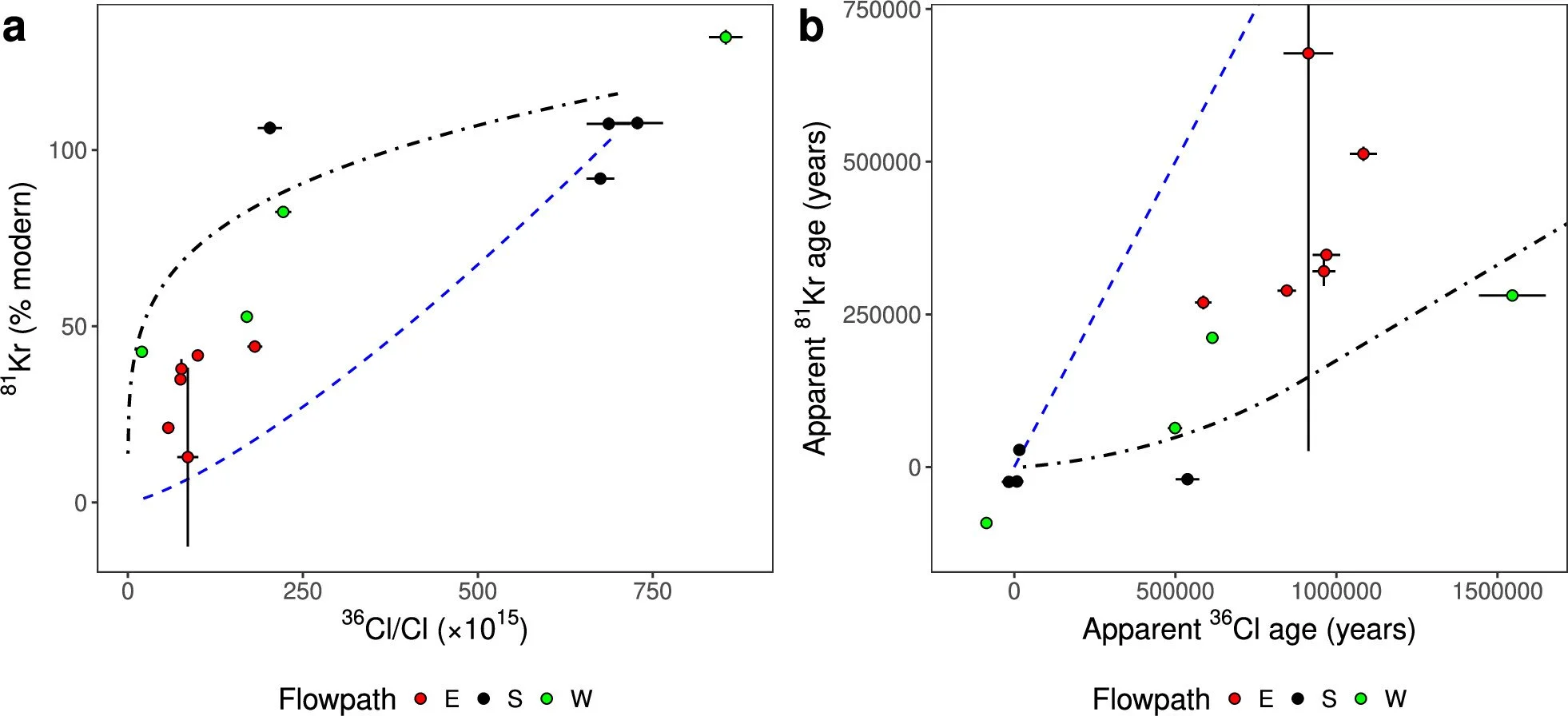
Fig. 6. Comparison of modeled and observed ³⁶Cl/Cl and ⁸¹Kr behavior in (a) activity–activity space and (b) apparent piston-flow age–age space. Observations include propagated analytical uncertainties. The blue dashed line represents the piston-flow reference corresponding to the diffusion-free simulation. The black dot-dashed line shows the extended model trend derived from the HGS ensemble simulations. In panel a, the ensemble mean relationship was extrapolated to lower activities using a log–log linear regression fitted to the simulated tracer activities. In panel b, a generalized additive model fitted in log–log space was used to represent the nonlinear relationship between apparent ages, and the resulting trend was converted to apparent ages using isotope-specific decay equations.
In contrast, krypton-81 (⁸¹1Kr) proved far less sensitive to diffusion-controlled transport processes. HydroGeoSphere simulations showed that while diffusion contributed substantially to changes in chlorine isotope systematics, its effect on⁸¹Kr concentrations was comparatively minor. This finding confirms that ⁸¹Kr provides a more robust and reliable tracer for dating fossil groundwater in the Milk River Aquifer and similar sedimentary basin systems where aquifer–aquitard exchange occurs over geological timescales.
HydroGeoSphere was essential to this research because it enabled the explicit simulation of coupled groundwater flow and isotope transport processes, including advection, diffusion, dispersion, and radioactive decay within a fully integrated framework. By linking field observations with process-based numerical modeling, the researchers were able to quantify the role of matrix diffusion, reconcile long-standing discrepancies between tracer-based and hydraulic age estimates, and improve understanding of groundwater evolution in one of North America’s most important fossil groundwater resources.
This work highlights the importance of integrated hydrologic and transport modeling when interpreting environmental tracer data and demonstrates how HydroGeoSphere can help improve groundwater age assessments in complex aquifer systems. The findings provide valuable guidance for managing long-lived groundwater resources and support the development of more reliable approaches for evaluating groundwater sustainability in sedimentary basins worldwide.
Abstract:
Krypton-81 (⁸¹Kr) and chlorine-36 (³⁶Cl) are among the few isotopic tracers capable of constraining groundwater residence times on 10⁵–10⁶ year timescales. In sedimentary aquifer systems bounded by low-permeability units, however, diffusive solute exchange can strongly modify tracer distributions and bias apparent ages derived from concentration ratios. In the transboundary Milk River Aquifer (MRA), progressive chloride enrichment caused by diffusion across shale aquitards complicates the interpretation of ³⁶Cl/Cl as a chronometer. Here, we combine new measurements of ⁸¹Kr, ³⁶Cl, stable chlorine isotopes (³⁷Cl/³⁵Cl)), and ¹⁴C with advection–diffusion transport modeling to quantify the importance of matrix diffusion on tracer systematics and inferred groundwater ages. The simulations reproduce the observed decrease in ³⁶Cl/Cl and concomitant increase in δ³⁷Cl along regional flow paths, demonstrating that diffusive influx of Cl-rich aquitard water dominates the evolution of the chlorine isotope system. In contrast, modeled and observed ⁸¹Kr activities show substantially lower sensitivity to diffusive exchange over the timescales considered. A comparison of simulated and measured tracer relationships indicates that, in the MRA, apparent ages derived from ³⁶Cl primarily reflect chloride addition rather than radioactive decay, whereas ⁸¹Kr provides a more robust and conservative chronometer for fossil groundwater. These results highlight the value of integrating stable and radioactive chlorine isotopes with noble gas dating and explicit transport modeling to disentangle decay from transport effects. The approach developed here provides a quantitative framework for interpreting multitracer data sets in regional aquifers affected by long-term diffusive exchange and has broader implications for assessing fossil groundwater resources in similar hydrogeological settings.