
HGS RESEARCH HIGHLIGHT – Effects of Creek Topology on Salinization of Coastal Marsh Due To Storm Surges

Yu, S., Li, X., Liu, J., Brunner, P., Yao, R., Yuan, B., Cai, X., & Yu, X. (2026). Effects of Creek Topology on Salinization of Coastal Marsh Due To Storm Surges. Water Resources Research, 62(4). https://doi.org/10.1029/2025wr041838
“HGS simulates advective-dispersive-diffusive salt transport under variably saturated, variable density conditions and has been previously used for simulations of storm surge introduced salinization”
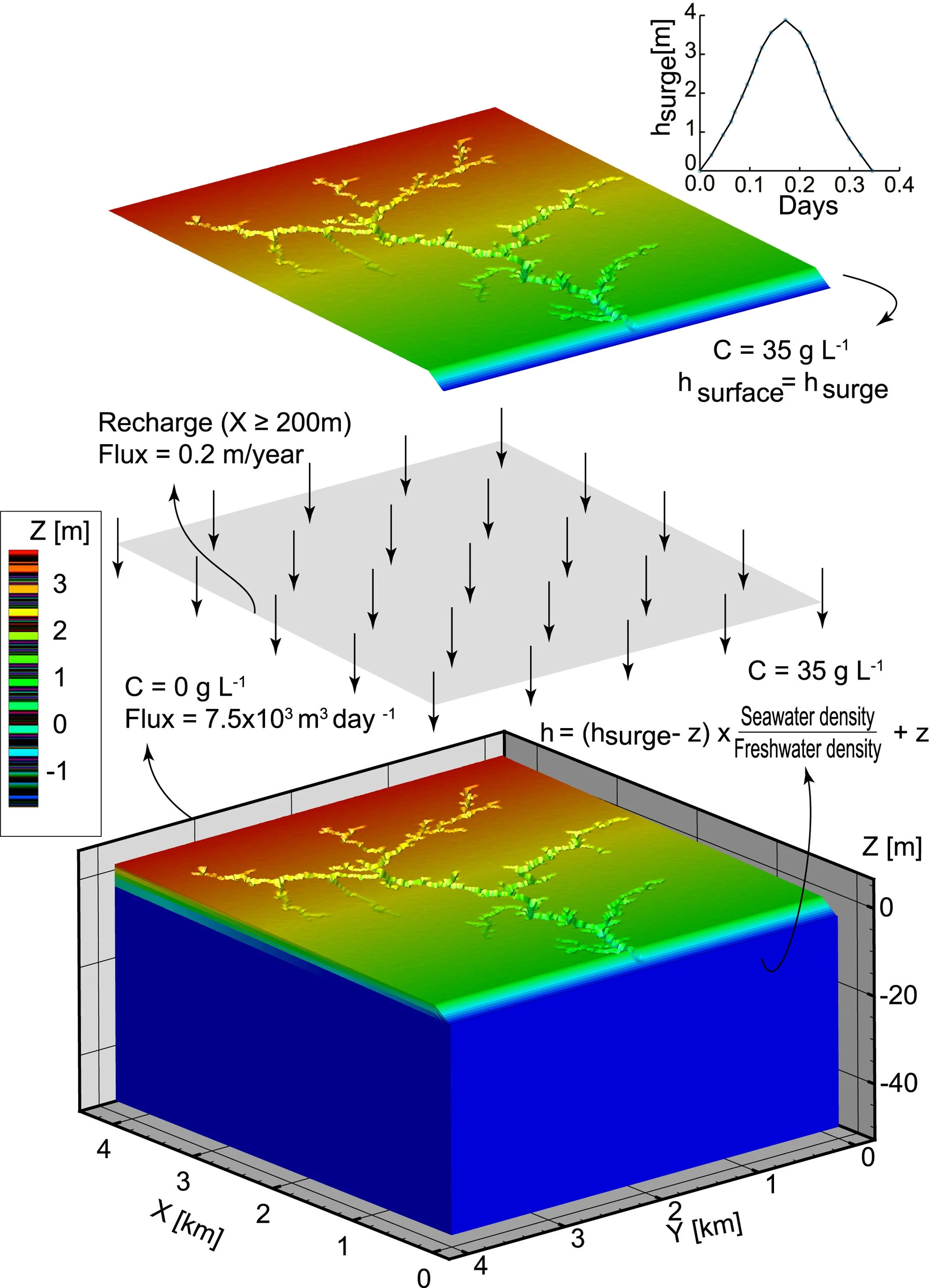
Fig. 3. Boundary conditions for modeling flow and salt transport due to a storm surge event.
We’re pleased to highlight this publication, co-authored by Shuangshuang Yu and colleagues, which investigates how creek network topology influences storm-surge-driven salinization in coastal marsh systems. This study leverages HydroGeoSphere (HGS) to simulate coupled surface–subsurface flow and salt transport processes under variable-density conditions, addressing long-standing challenges in understanding how geomorphology controls vertical saltwater intrusion and recovery in marsh environments.
Traditional studies of storm-surge-induced salinization often simplify surface inundation processes or represent them using fixed boundary conditions, limiting their ability to capture interactions between surface flow, groundwater exchange, and salt transport. While these approaches provide insight into subsurface salinity dynamics, they frequently overlook how creek morphology alters the pathways and persistence of saline water across marsh platforms. By applying HydroGeoSphere to simulate transient storm surge overwash events across synthetic creek-network configurations, this research provides a physically consistent framework for evaluating how surface–subsurface interactions control salinization patterns.
The study applied stochastic morphodynamic modeling to generate sparse, intermediate, and dense creek-network scenarios, which were then simulated using a fully coupled flow and transport model to evaluate inundation extent, saltwater intrusion, and recovery dynamics. Results showed that dense creek networks attenuated storm-surge inundation and confined saline water primarily to marsh surfaces, reducing aquifer salinization, while sparse networks increased reverse groundwater flow and delayed salt flushing across the system. Recovery patterns varied substantially between creeks, marsh sediments, and aquifers, demonstrating nonlinear responses to storm-surge forcing controlled by creek topology.
Key findings showed that creek topology strongly influences both the spatial distribution of storm-surge inundation and the long-term recovery of salinized coastal aquifers. Dense creek systems dissipated surge energy more effectively and reduced inland groundwater salinization, whereas sparse creek networks promoted localized flooding and prolonged salt retention in subsurface environments. These results highlight the importance of representing geomorphologic complexity when evaluating coastal resilience to storm-driven salinity intrusion.
HydroGeoSphere proved essential in enabling this work due to its ability to simulate variably saturated, variable-density flow and advective–dispersive salt transport within a fully integrated surface–subsurface modeling framework. This capability allowed the researchers to evaluate how storm surge inundation interacts dynamically with groundwater systems across different creek-network configurations over multi-decadal recovery timescales.
This research provides critical insights for coastal hydrology, ecosystem restoration, and salinity management, demonstrating that advanced modelling approaches like HydroGeoSphere can improve predictions of storm-surge impacts in marsh environments. By linking geomorphologic structure with salinization dynamics, the study supports more informed strategies for managing coastal wetlands under increasing climate-driven storm risk.
Abstract:
Creek topology varies widely across coastal marshes and strongly influences surface and subsurface flow patterns. These flow dynamics, in turn, affect salt transport within the marsh system. Both processes are critical in storm surge inundation and consequent subsurface salinization. In this study, we employed modeling tools to understand the role of creek networks in salt transport due to storm surges. We developed a stochastic morphodynamic model to represent three typical creek network groups: sparse, intermediate, and dense groups. We then utilized a variable-density, coupled surface-subsurface, flow and salt transport model to simulate a theoretical storm surge overwash event. We examined how the presence of creek affects the extent and location of salinization by evaluating differences in salinity of surface waters and the subsurface. The salinization assessment showed that dense creek networks attenuated storm surge inundation and limited the surface salinization extent. The highest occurrence of reverse creek and groundwater flow directions was found in the sparse group, which delayed the salt flushing. The recovery from salinization varies nonlinearly in creek water, marsh sediments, and aquifers. Our study suggests that creek topology significantly affects the resilience of coastal marshes to storm surge salinization, with important implications for coastal land management and ecosystem restoration.