
HydroSphereAI Case Study: Spring Freshet Forecasting for Hydropower Risk Awareness – Vermilion River Ontario (Station: 02CF011 - VERMILION RIVER NEAR VAL CARON) – April 2026
HydroSphereAI’s machine learning-driven forecasting system.
Between April 15 and April 22, 2026, watersheds across Greater Sudbury experienced a significant spring flood event driven by rapid snowmelt and sustained rainfall. A Flood Warning issued by Conservation Sudbury highlighted elevated inflows across the region, including the Vermilion River system near Val Caron.
While the Vermilion River is not a regulated hydropower system, Water Survey of Canada Station 02CF011 (Vermilion River near Val Caron) provides a comparable watershed area for understanding naturalized inflow dynamics relevant to hydroelectric operations across northern Ontario.
This case study demonstrates how HydroSphereAI (HSAI) captured the timing and magnitude of peak flows during a complex spring freshet event, and how similar forecasting capability can support hydropower decision-making.
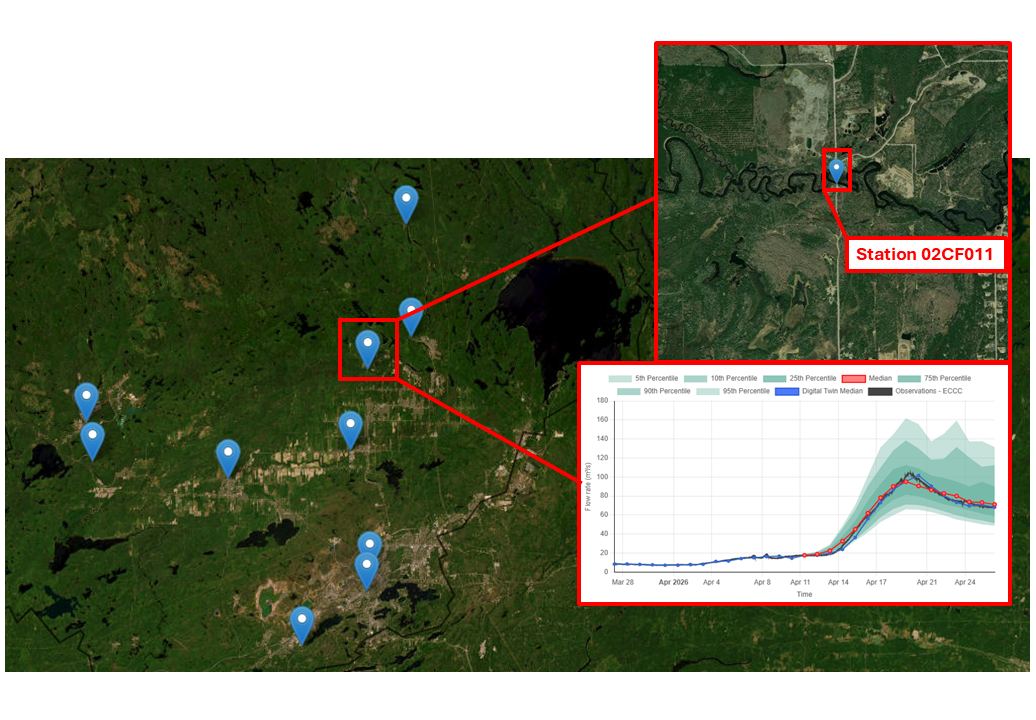
Vermilion River Ontario. Vermilion River near Val Caron (Station 02CF011).
Why This Event Matters for Hydropower
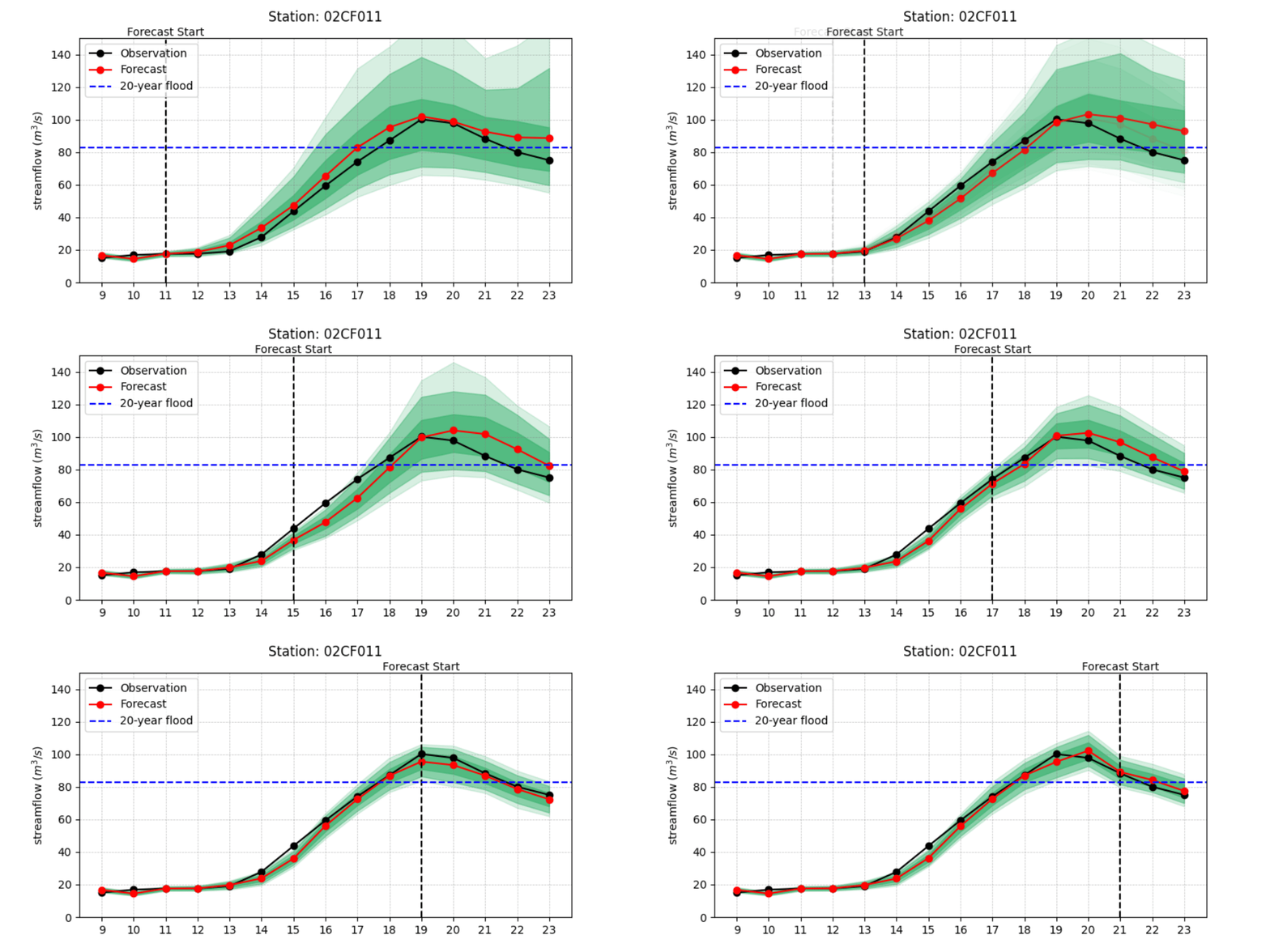
Spring freshet events represent one of the most operationally challenging periods for hydroelectric utilities. Even in unregulated basins like the Vermilion River, the hydrologic behaviour observed is directly transferable to regulated systems. During this event rapid snowmelt combined with rainfall generated sustained high inflows. Peak discharge of 104 m^3/s occurred on April 19, following several days of rising flow, with flows exceeding 83 m^3/s (a 1 in 20 year flow rate) for 4 consecutive days from 2am on April 18th until 11pm on April 21st. Flood warnings were issued by Conservation Sudbury on April 15th and April 17th, highlighting Val Caron and surrounding areas as high-risk zones.
For hydropower operators, similar inflow conditions can translate to reservoir level exceedance risk, spillway activation and flood routing decisions, reduced flexibility in generation scheduling and increased downstream flood liability.
Comparable Watershed for Regulated Systems
The Vermilion River basin upstream of station 02CF011 exhibits characteristics common to many hydroelectric operational locations in Ontario, including a mixed storage response (lakes and wetlands) , snowmelt-dominated hydrology, sensitivity to rain-on-snow events and multi-day hydrograph peaks rather than flash responses. Although no dam is present at this site, the observed inflow dynamics closely resemble naturalized inflows to hydroelectric reservoirs, making it an ideal test case for forecasting performance.
Forecasting Challenge for Hydropower Operations
Spring inflow forecasting is particularly complex due to uncertainty in snow water equivalent and melt rates and nonlinear runoff generation during rain-on-snow events. The temperature-driven variability in timing of peak inflows and prolonged inflow periods often require multi-day operational planning. For hydroelectric facilities, the key challenge is not just predicting that inflows will rise, but accurately forecasting when peak inflow will occur, what maximum flow rates to expect, and how long elevated inflows will persist.
HydroSphereAI Performance Overview
HydroSphereAI demonstrated strong predictive capability at station 02CF011 (Vermilion River near Val Caron) throughout the event:
April 11 (8-day lead time):
Early forecasts identified a developing inflow event, providing advance notice of potential operational stress. The model was already tracking the timing and magnitude of peak inflow with high accuracy, enabling early planning.April 15–22 (Flood Warning period):
Forecasts remained stable as inflows increased, aligning closely with observed hydrograph trends. Short-range forecasts (1–3 day lead time) performed particularly well between April 17 and April 20, closely matching both the rate of rise and sustained peak conditions, further reinforcing confidence during critical operational decision-making periods.Peak Capture (April 19):
HydroSphereAI accurately predicted the timing of peak inflow, maintaining consistency throughout.Forecast Convergence:
As lead time decreased, uncertainty narrowed, supporting higher-confidence operational decisions.
Operational Value for Hydropower
HydroSphereAI’s performance in this event highlights several direct applications for hydroelectric operators:
Advanced Inflow Forecasting
Early detection (up to 10 days ahead) enables pre-emptive reservoir drawdown and optimization of storage capacity ahead of peak inflow.Surplus Flow and Flood Management
Accurate peak timing supports controlled spillway operations and reduced downstream flood risk.Generation Optimization
Reliable inflow forecasts allow operators to maximize generation during high inflow periods and avoid reactive or suboptimal dispatch decisions.Risk Reduction
Improved foresight can improve emergency operational responses and reduces infrastructure stress during peak events.
Conclusion
The April 2026 spring freshet event across the Sudbury region illustrates the type of inflow dynamics that hydroelectric operators must manage each year. Even in an unregulated system like the Vermilion River, the observed hydrologic response, driven by snowmelt, rainfall, and basin storage, closely mirrors conditions experienced at hydroelectric reservoirs.
HydroSphereAI’s ability to detect early inflow signals , accurately forecast peak timing and maintain consistency across a multi-day event demonstrates its value as a decision-support tool for hydropower operations. As climate variability increases the uncertainty and intensity of spring inflows across Canada, AI-driven forecasting platforms like HydroSphereAI provide utilities with the actionable intelligence needed to improve reservoir management, optimize generation, and enhance flood resilience.