
HydroSphereAI Case Study: Sydenham River at Florence
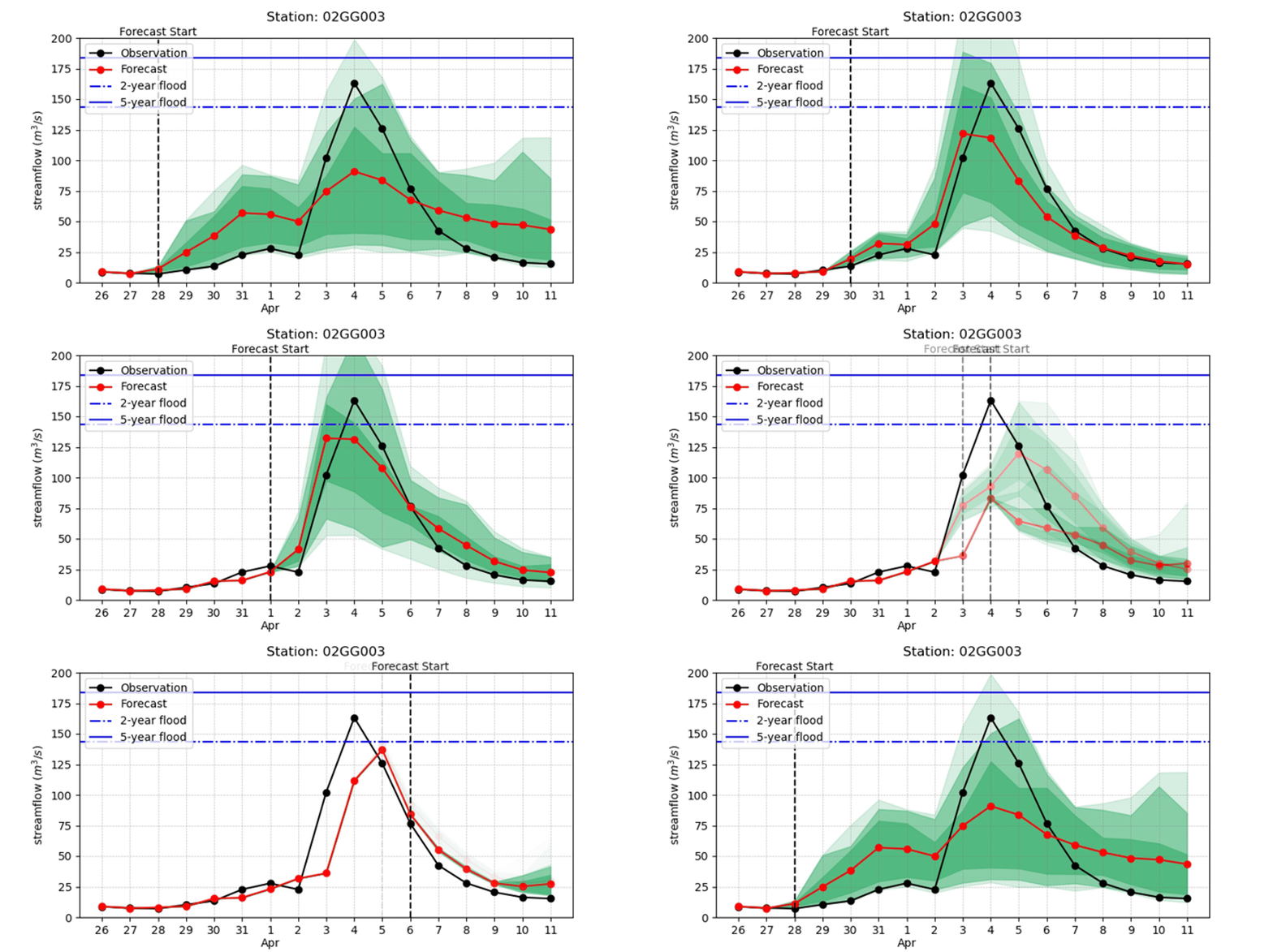
In early April 2025, the St. Clair Region Conservation Authority issued a Flood Warning for the Sydenham River watershed, anticipating a significant rise in flows as a forecasted weather system approached the region. With much of the snowpack already depleted— leaving a modest 39.1 mm of snow water equivalent (SWE)— the primary concern was intense rainfall over already saturated ground. For the Sydenham River at Florence (Station 02GG003), this event culminated in a peak flow of 169.0 m³/s on April 4, surpassing the 2-year flood threshold of 143.3 m³/s and coming close to the 5-year return period marker of 183.7 m³/s.
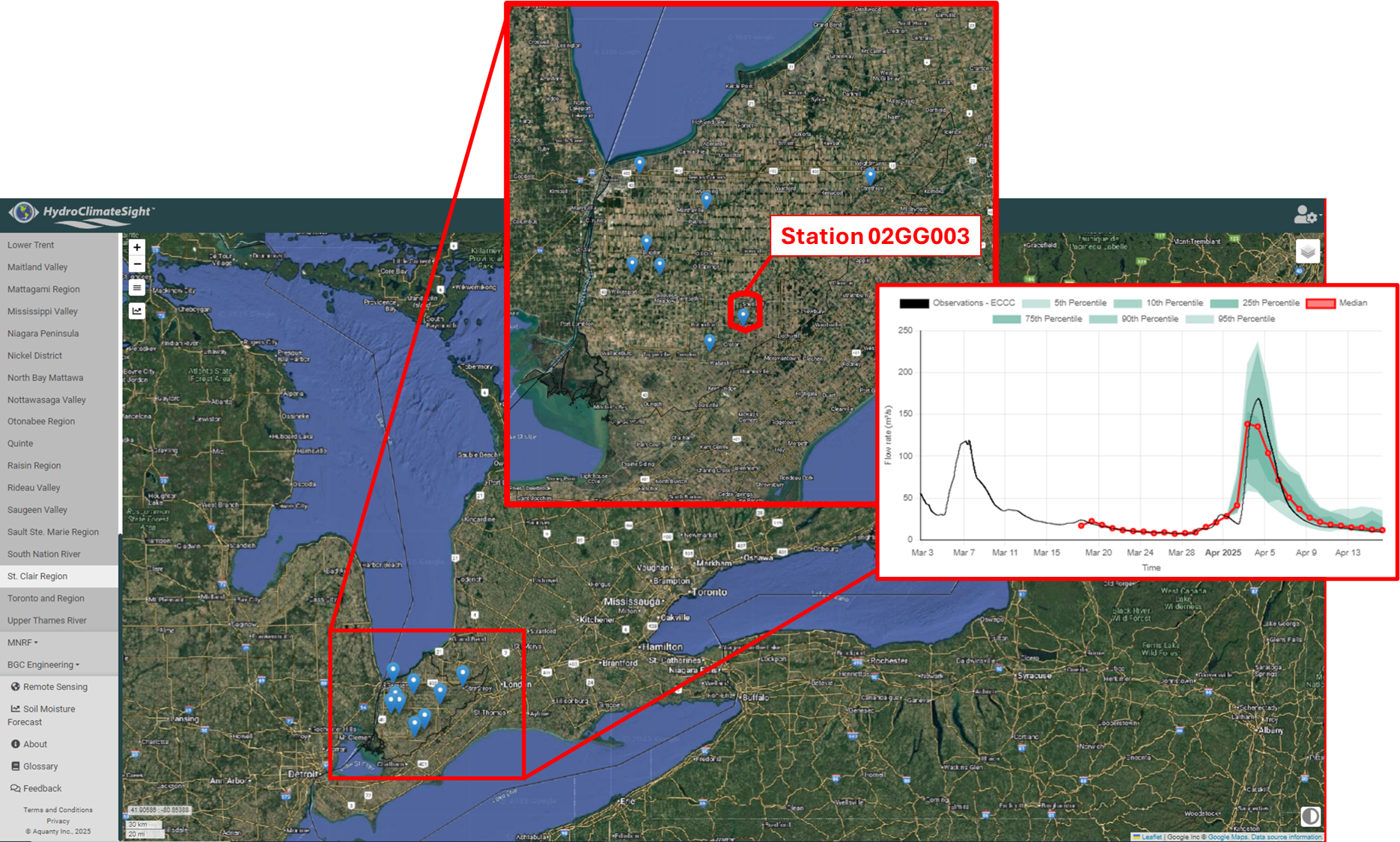
The Sydenham River watershed in southern Ontario is located right outside of St. Clair Region. Station 02GG003 is found on the Sydenham River near the community of Florence.
As this event unfolded, Aquanty’s HydroSphereAI (HSAI) machine learning-based streamflow forecasting platform tracked and predicted the rising flows in real time. Forecasts issued in the days prior showed a clear rising trend in the ensemble spread, indicating potential flood conditions. While median predictions slightly underestimated the final peak, the actual observed flow remained well within the upper bounds of the ensemble— providing local authorities with advanced situational awareness.
Forecasts leading up to April 4 highlighted a sharp hydrograph rise and accurately identified the timing of the peak. As new weather data became available, HydroSphereAI adjusted dynamically, with the April 3 forecast showing significant improvement over earlier runs. The ensemble spread narrowed meaningfully, and the median forecast moved closer to the observed flow. This convergence reinforced user confidence and exemplified how probabilistic models evolve with incoming data— transforming uncertainty into a well-informed picture of risk.
The system’s performance reflected HydroSphereAI’s known forecasting pattern: underpredicting extreme peaks slightly while successfully capturing timing and event structure. Given Environment Canada’s shifting weather forecasts— which began conservatively and grew more aggressive as the system approached— the ability of HSAI to adapt in real time was critical. Currently, HydroSphereAI integrates ECCC’s GEPS ensemble as its main meteorological input, and Aquanty continues to evaluate additional forecast sources to improve model responsiveness and resilience across varying watershed conditions.
Importantly, this event seems to have been driven almost entirely by precipitation rather than snowmelt— emphasizing the need to monitor rainfall-dominant events closely as they become more common under changing climate conditions.
Even though the precise magnitude was slightly underforecasted, HydroSphereAI’s ensemble outputs delivered a strong, clear signal of flood risk and ensured users could prepare with confidence. The platform did not just project a single number— it communicated a range of possibilities.
In the Sydenham River watershed, HydroSphereAI was able to provided a timely, transparent, and evolving forecast. As climate change increases the frequency and unpredictability of intense precipitation events, HydroSphereAI can play a vital role in proactive modern water management to improve flood alerting and response, and ensure public safety.