
HGS RESEARCH HIGHLIGHT – Hybrid deep learning-numerical modeling framework for long-term prediction of groundwater discharge and radionuclide transport
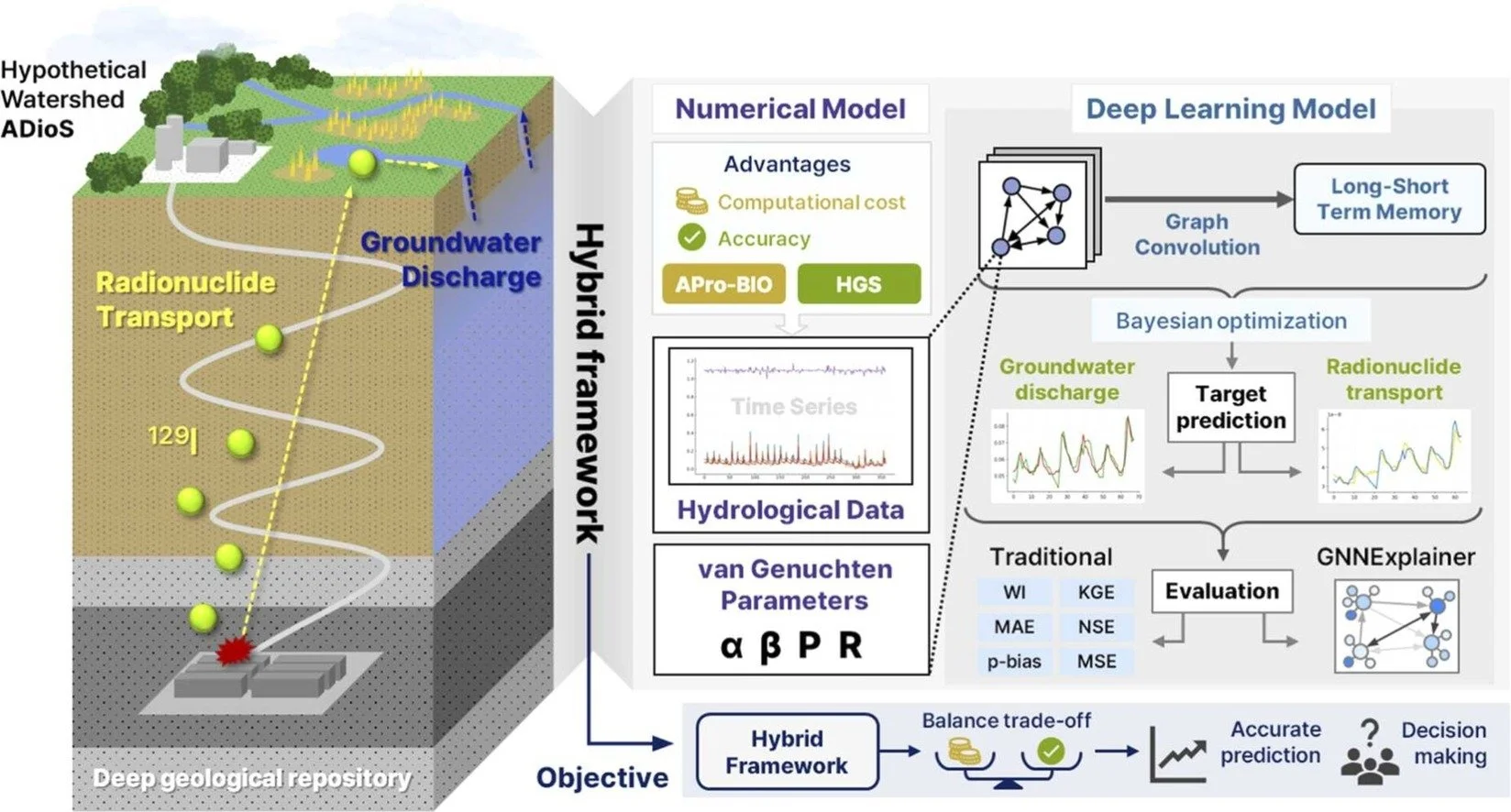
We're pleased to highlight this publication by Minkyeong Seong and colleagues, which presents a hybrid deep learning–numerical modelling framework for improving long-term predictions of groundwater discharge and radionuclide transport. Using HydroGeoSphere (HGS) as the physics-based reference model, the researchers combined process-based numerical modelling with a graph convolutional long short-term memory (GC-LSTM) deep learning model to achieve highly accurate long-term predictions while dramatically reducing computational costs.
Long-term prediction of groundwater flow and radionuclide transport is essential for evaluating the safety of deep geological repositories used to store radioactive waste. While fully integrated numerical models such as HydroGeoSphere provide highly accurate simulations of coupled surface water, groundwater, and contaminant transport processes, these simulations can become computationally demanding for assessments spanning decades or even millions of years. Simpler models offer faster runtimes but often sacrifice accuracy by neglecting important processes such as unsaturated flow. This study addresses that challenge by combining the strengths of physics-based modelling with artificial intelligence to improve both efficiency and predictive performance.
HGS RESEARCH HIGHLIGHT – Modeling a geologically complex volcanic watershed for integrated water resources management in Mt. Fuji, Japan
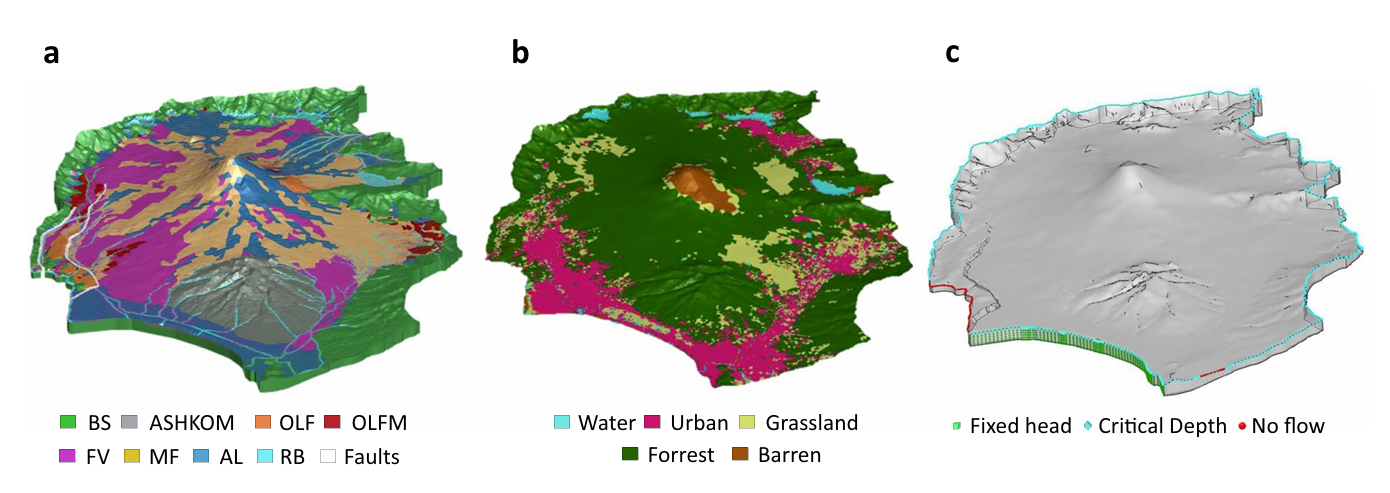
This publication presents a three-dimensional geological and integrated hydrological modelling dataset developed for the Mt. Fuji volcanic watershed in Japan. This study leverages HydroGeoSphere (HGS) to simulate coupled surface–subsurface flow and transport processes in a geologically complex volcanic catchment, addressing long-standing challenges in representing groundwater flow pathways and hydrologic interactions in structurally heterogeneous mountain environments. The resulting dataset provides a physically consistent modelling framework to support interdisciplinary water resources research and scenario-based hydrologic simulations.

Staff Research Highlight - A dynamic meshing scheme for integrated hydrologic modeling to represent evolving landscapes
Aquanty is pleased to introduce a novel dynamic meshing scheme for integrated hydrologic modelling with HydroGeoSphere to better represent evolving landscapes. The approach addresses a major challenge in modelling human-altered environments, particularly in regions undergoing rapid changes such as open-pit mining sites, land reclamation zones, or urban developments. Traditional hydrologic models often rely on static mesh geometries, limiting their ability to capture changes in topography and subsurface structure over time. This research proposes a more flexible, adaptive framework capable of simulating surface and subsurface hydrologic responses to complex engineering activities.