
HGS RESEARCH HIGHLIGHT – Impact of River Morphology on River–Groundwater Exchange in Braided River Systems
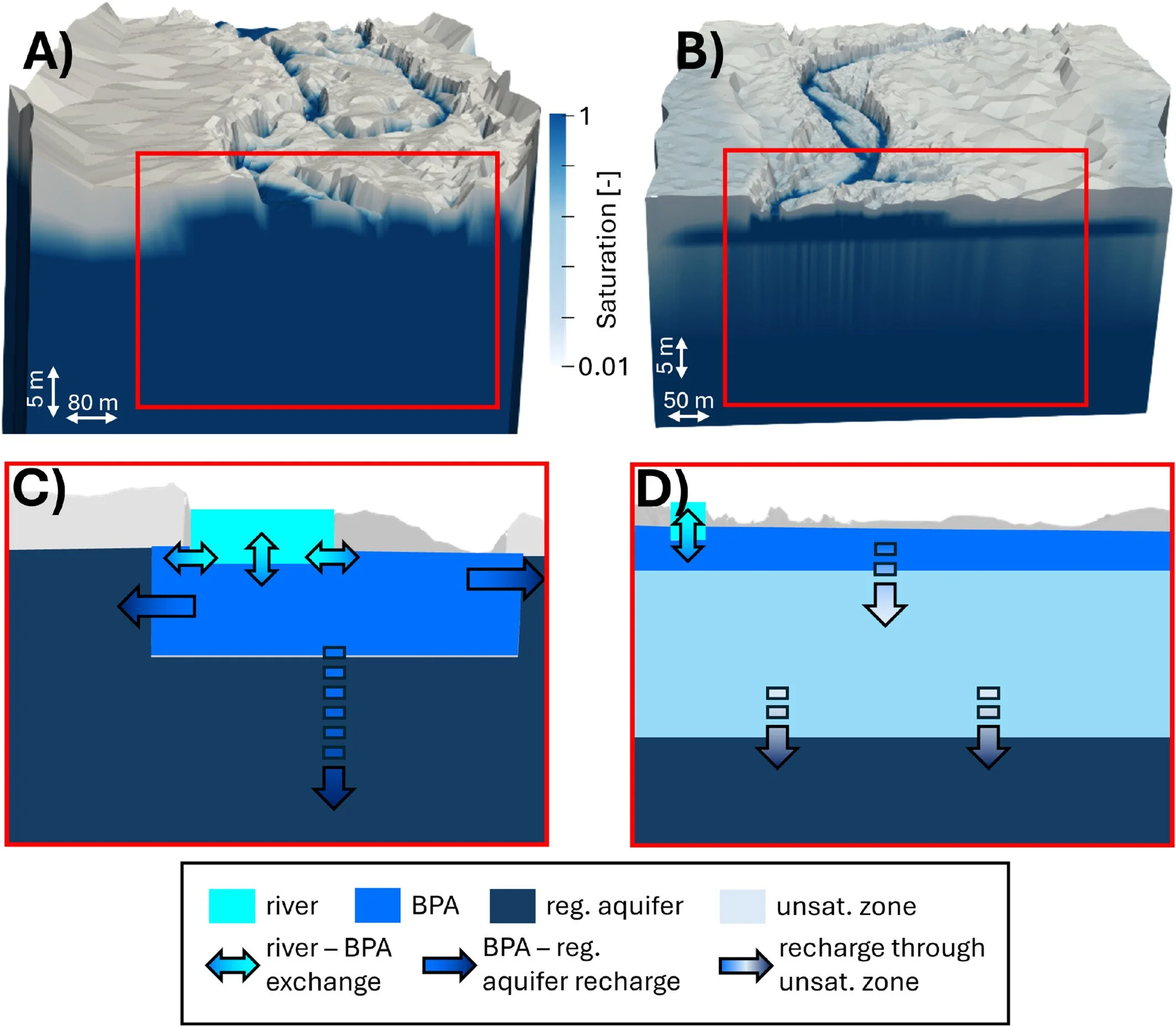
We're pleased to highlight this publication by Thomas Wöhling, Moritz Kraft and Antoine Di Ciacca, which investigates how flood-driven changes in braided river morphology influence river–groundwater exchange and aquifer recharge. Using HydroGeoSphere (HGS), the researchers developed fully coupled surface water–groundwater models of two braided river systems in New Zealand to isolate the effects of changing riverbed morphology before and after major flood events. The study demonstrates that morphological changes alone can significantly alter both recharge to shallow braidplain aquifers and subsequent recharge to regional groundwater systems.

Staff Research Highlight - Understanding topography-driven groundwater flow using fully-coupled surface-water and groundwater modeling
This research focuses on understanding the dynamics of topography-driven groundwater flow systems using fully-coupled surface–subsurface hydrologic modelling. This study addresses long-standing challenges in representing nested flow systems by simulating interactions between climate, topography, and groundwater without relying on potentially unrealistic, static boundary conditions.
Staff Research Highlight - A dynamic meshing scheme for integrated hydrologic modeling to represent evolving landscapes
Aquanty is pleased to introduce a novel dynamic meshing scheme for integrated hydrologic modelling with HydroGeoSphere to better represent evolving landscapes. The approach addresses a major challenge in modelling human-altered environments, particularly in regions undergoing rapid changes such as open-pit mining sites, land reclamation zones, or urban developments. Traditional hydrologic models often rely on static mesh geometries, limiting their ability to capture changes in topography and subsurface structure over time. This research proposes a more flexible, adaptive framework capable of simulating surface and subsurface hydrologic responses to complex engineering activities.

HGS RESEARCH HIGHLIGHT – Small-scale topography explains patterns and dynamics of dissolved organic carbon exports from the riparian zone of a temperate, forested catchment
Examining the intricate dynamics of dissolved organic carbon (DOC) exports from riparian zones (RZs), a recent study conducted by a team of researchers highlights the predominant controls governing DOC export.