
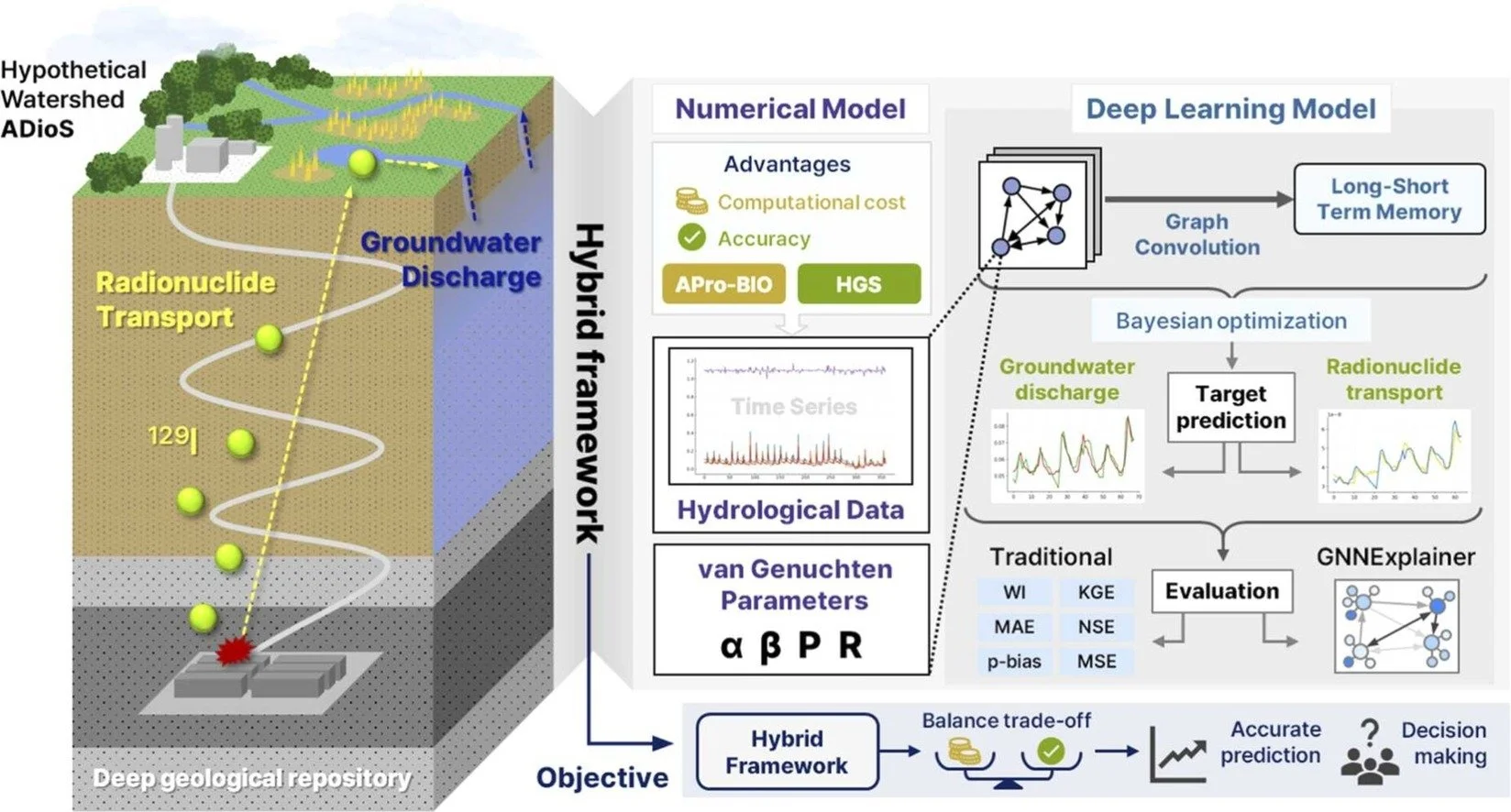
HGS RESEARCH HIGHLIGHT – Hybrid deep learning-numerical modeling framework for long-term prediction of groundwater discharge and radionuclide transport
We're pleased to highlight this publication by Minkyeong Seong and colleagues, which presents a hybrid deep learning–numerical modelling framework for improving long-term predictions of groundwater discharge and radionuclide transport. Using HydroGeoSphere (HGS) as the physics-based reference model, the researchers combined process-based numerical modelling with a graph convolutional long short-term memory (GC-LSTM) deep learning model to achieve highly accurate long-term predictions while dramatically reducing computational costs.
Long-term prediction of groundwater flow and radionuclide transport is essential for evaluating the safety of deep geological repositories used to store radioactive waste. While fully integrated numerical models such as HydroGeoSphere provide highly accurate simulations of coupled surface water, groundwater, and contaminant transport processes, these simulations can become computationally demanding for assessments spanning decades or even millions of years. Simpler models offer faster runtimes but often sacrifice accuracy by neglecting important processes such as unsaturated flow. This study addresses that challenge by combining the strengths of physics-based modelling with artificial intelligence to improve both efficiency and predictive performance.
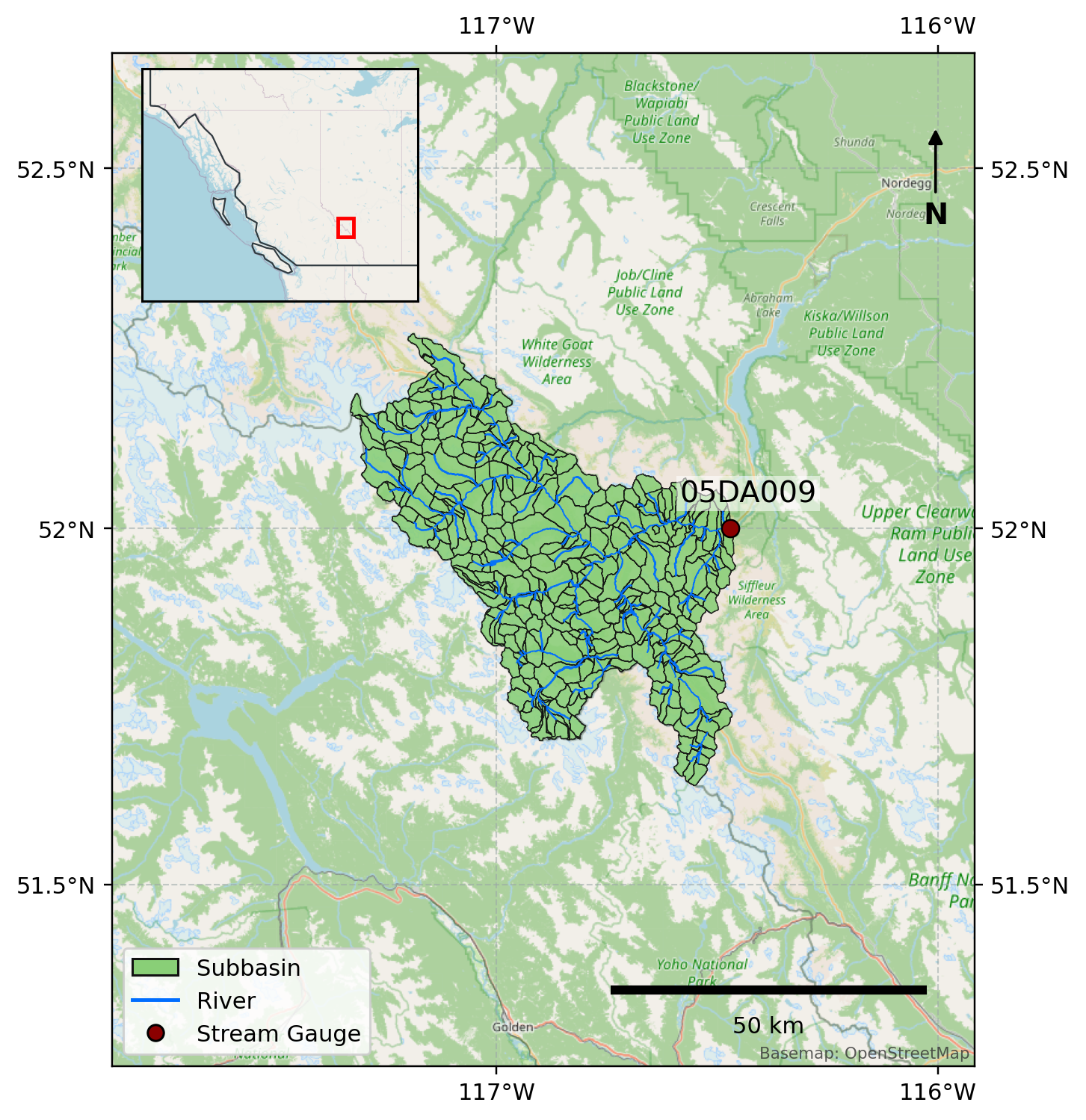
Delta-Models for Reservoir Operations – NORTH SASKATCHEWAN RIVER AT WHIRLPOOL POINT (05DA009)
The Bighorn dam is located in the foothills of the Canadian Rockies in Alberta and is one of TransAlta's major hydroelectric facilities, with a capacity of 120 MW and an average annual generation of approximately 408,000 MWh (Bighorn - TransAlta). Reservoir planning is important for hydropower operations because operators must balance water availability, storage constraints, generation demand, flood risk, and downstream flow requirements. In snowmelt dominated basins (like this one), reservoir inflow relies on both current streamflow and upstream watershed conditions which determine future water volumes over coming days, weeks, and months. These conditions include the amount of water stored as snowpack, the timing/rate of snowmelt, antecedent soil wetness, incoming precipitation, and changes in temperature.
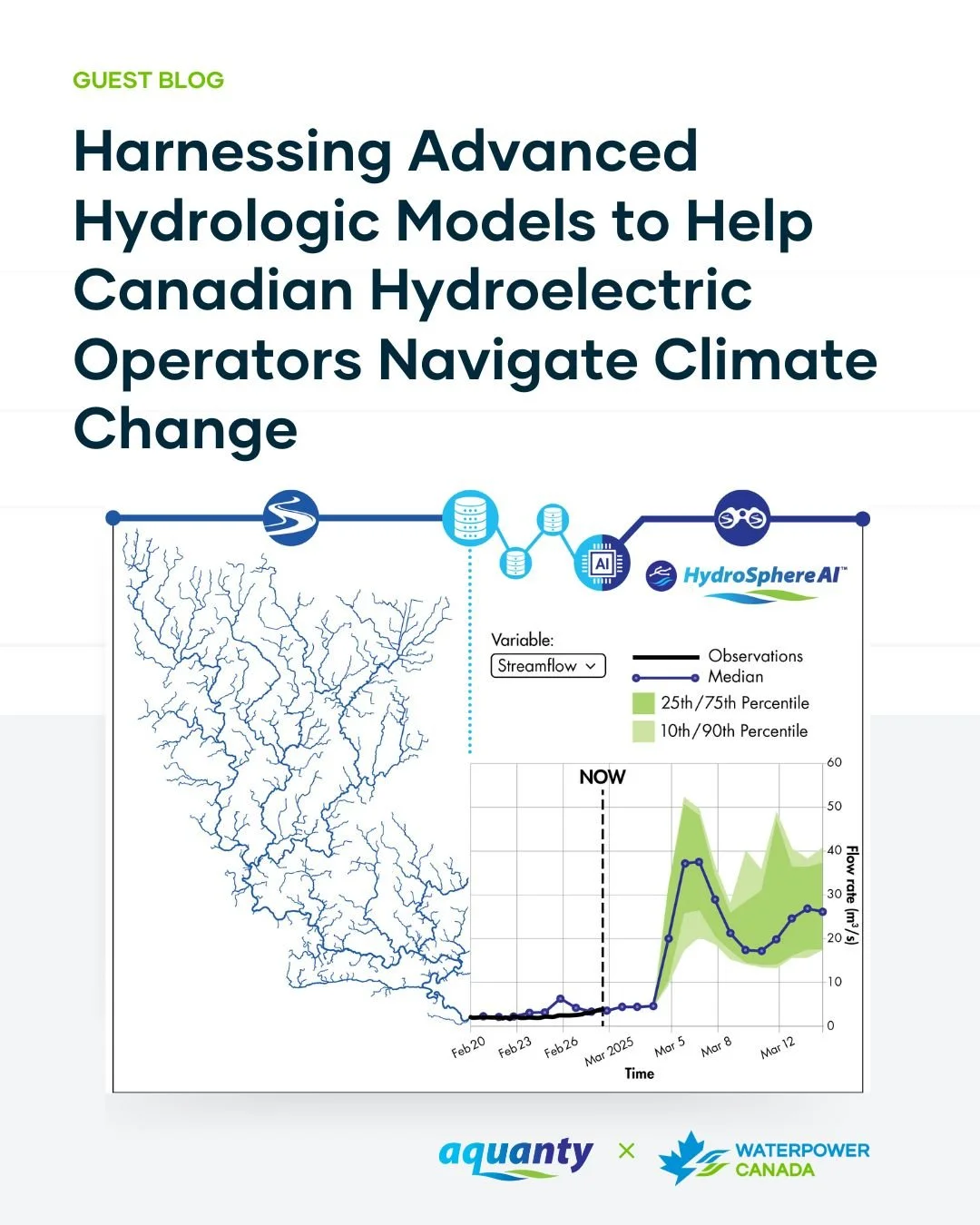
Aquanty Featured in WaterPower Canada Guest Blog: Navigating Climate Change in Hydropower
We’re pleased to share that Aquanty recently contributed a guest blog post to WaterPower Canada, authored by Dr. Andre Erler, Senior Climate Scientist at Aquanty. The article “Harnessing Advanced Hydrologic Models to Help Canadian Hydroelectric Operators Navigate Climate Change” explores how advanced hydrologic modelling and forecasting tools can help Canadian hydroelectric operators navigate increasing uncertainty driven by climate change.
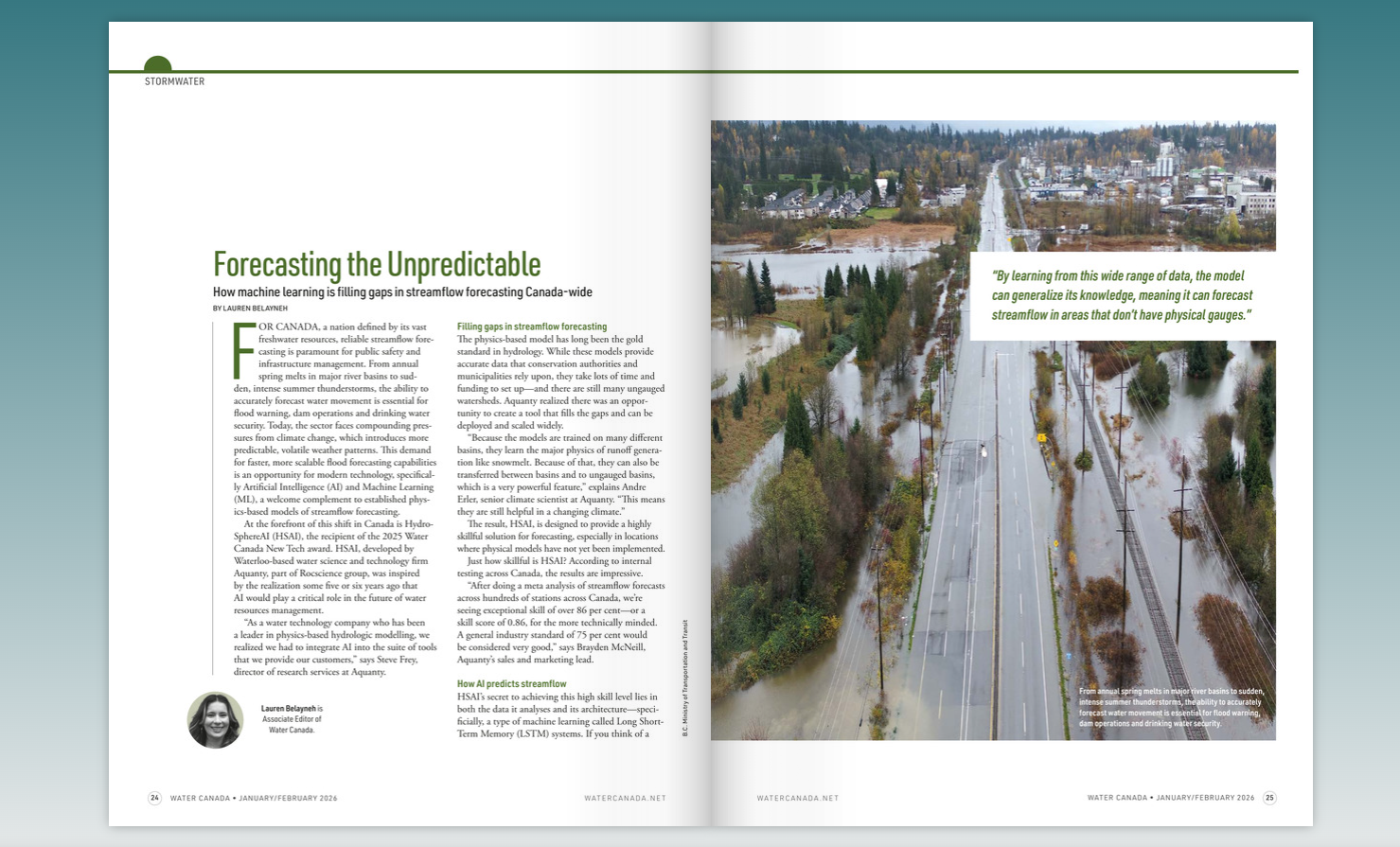
HydroSphereAI Featured in Water Canada’s January/February 2026 Magazine
We’re excited to share that HydroSphereAI (HSAI) is featured in the January/February 2026 issue of Water Canada, highlighting how machine learning is helping close critical gaps in streamflow forecasting across Canada.

HydroSphereAI — Aquanty’s Artificial Intelligence Platform — has won the Water Canada New Tech Award for 2025.
Aquanty is proud to announce that our latest innovation — HydroSphereAI — has won the New Tech Award at the 2025 Water Canada Awards.

HydroSphereAI Selected as Finalist for New Tech Award - Water Canada Awards
Aquanty Inc. is proud to announce that we have once again been selected as a finalist for the New Tech Award at the 2025 Water Canada Awards for our cutting-edge, machine-learning-based streamflow forecasting system, HydroSphereAI.

HydroSphereAI Case Study: Sauble River at Allenford — Spring Melt 2025
Using HydroSphereAI to anticipate and understand flood risks in real time and in retrospect. In late March and in the first days of April 2025, the Grey Sauble Conservation Authority issued an “All Watersheds” Flood Watch in anticipation of significant rainfall and elevated flows. A forecasted weather system was expected to bring up to 50 mm of total precipitation, following weeks of already saturated conditions. For the Sauble River at Allenford (Station 02FA004), this setup resulted in two distinct streamflow peaks within a five-day span— first on March 30, then again on April 3. Looking at both peaks, HydroSphereAI consistently delivered strong performance in predicting the structure and timing of the events.

HydroSphereAI: Next-Generation Hydrological Forecasting & AI-Driven Insights for a Changing Climate
We’re excited to share the recording of our recent webinar, HydroSphereAI: Machine Learning-Driven Insights and Hydrological Forecasting in a Changing Climate.
This session offers a deep dive into how cutting-edge machine learning approaches are transforming streamflow prediction and hydrological forecasting across Canada.
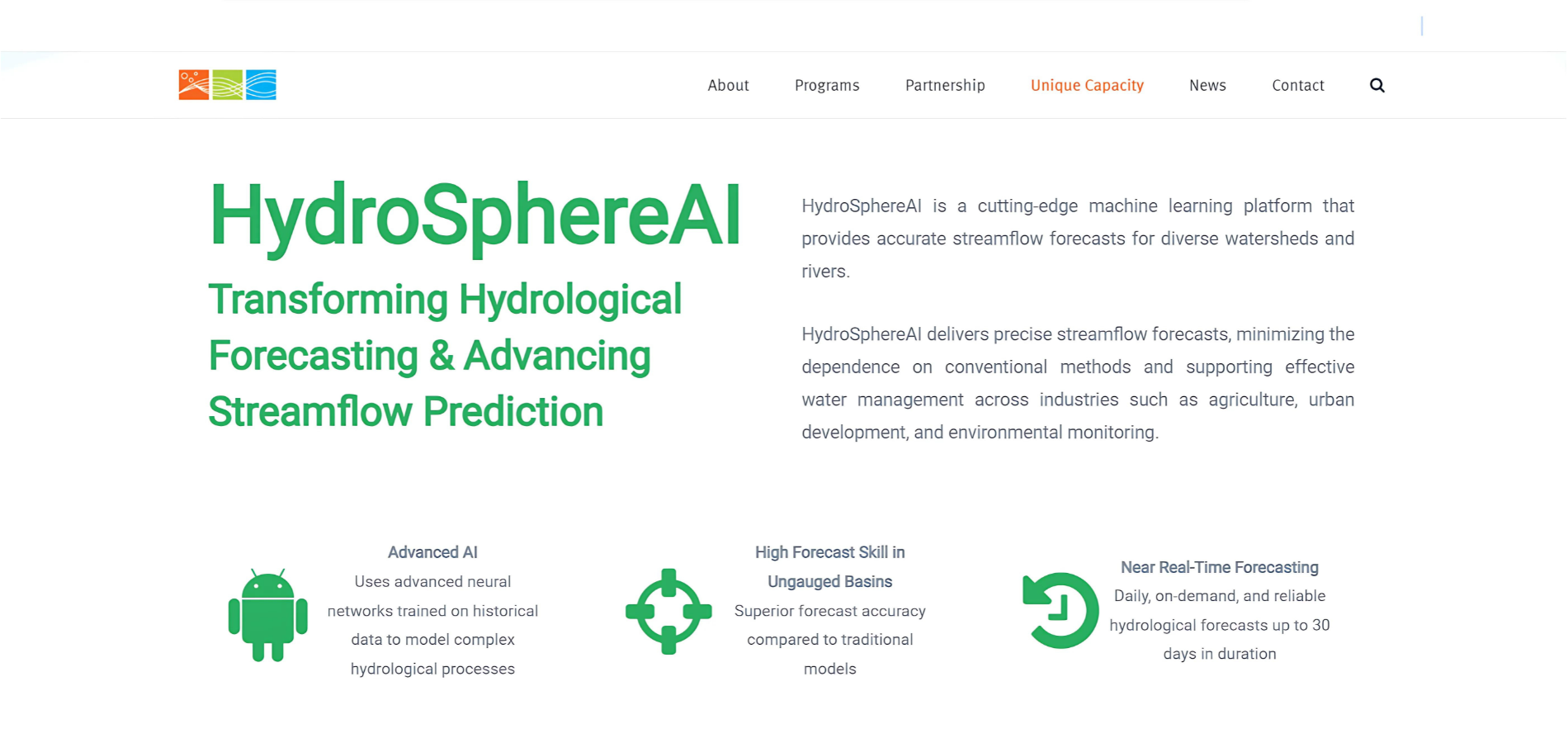
HydroSphereAI featured in OWC’s Innovation Showcase
We’re proud to share that Aquanty’s cutting-edge hydrological forecasting tool HydroSphereAI is now featured in the Ontario Water Consortium (OWC) Innovation Showcase. The OWC highlights our machine-learning based streamflow forecasting tool, designed to address the complex water management challenges of today and position Aquanty as a leader in hydrological forecasting solutions.

“Homegrown Technologies Could Play a Key Role in the World’s Water Future” - Aquanty Featured in CWRA’s Water News Magazine
We’re proud to share that Aquanty has been highlighted in a recent issue of the CWRA’s Water News Magazine. This article explores the innovative tools we’ve developed to tackle 21st-century water resource challenges, positioning Aquanty as a leader in hydrologic system modelling both in Canada and internationally.