
OWC Innovation Showcase Fall Series Recap - Forecasting a Changing Climate: AI, Flood Resilience and the Future of Ontario’s Watersheds
We’re pleased to share the recording of the Ontario Water Consortium’s (OWC) Innovation Showcase Fall 2026 webinar, Forecasting a Changing Climate: AI, Flood Resilience and the Future of Ontario’s Watersheds. This panel discussion, featuring Dr. Andre R. Erler alongside experts from Conservation Ontario, Maitland Valley Conservation Authority, and Western University, explores how artificial intelligence, advanced forecasting technologies, and operational expertise can strengthen flood preparedness and watershed resilience across Ontario.
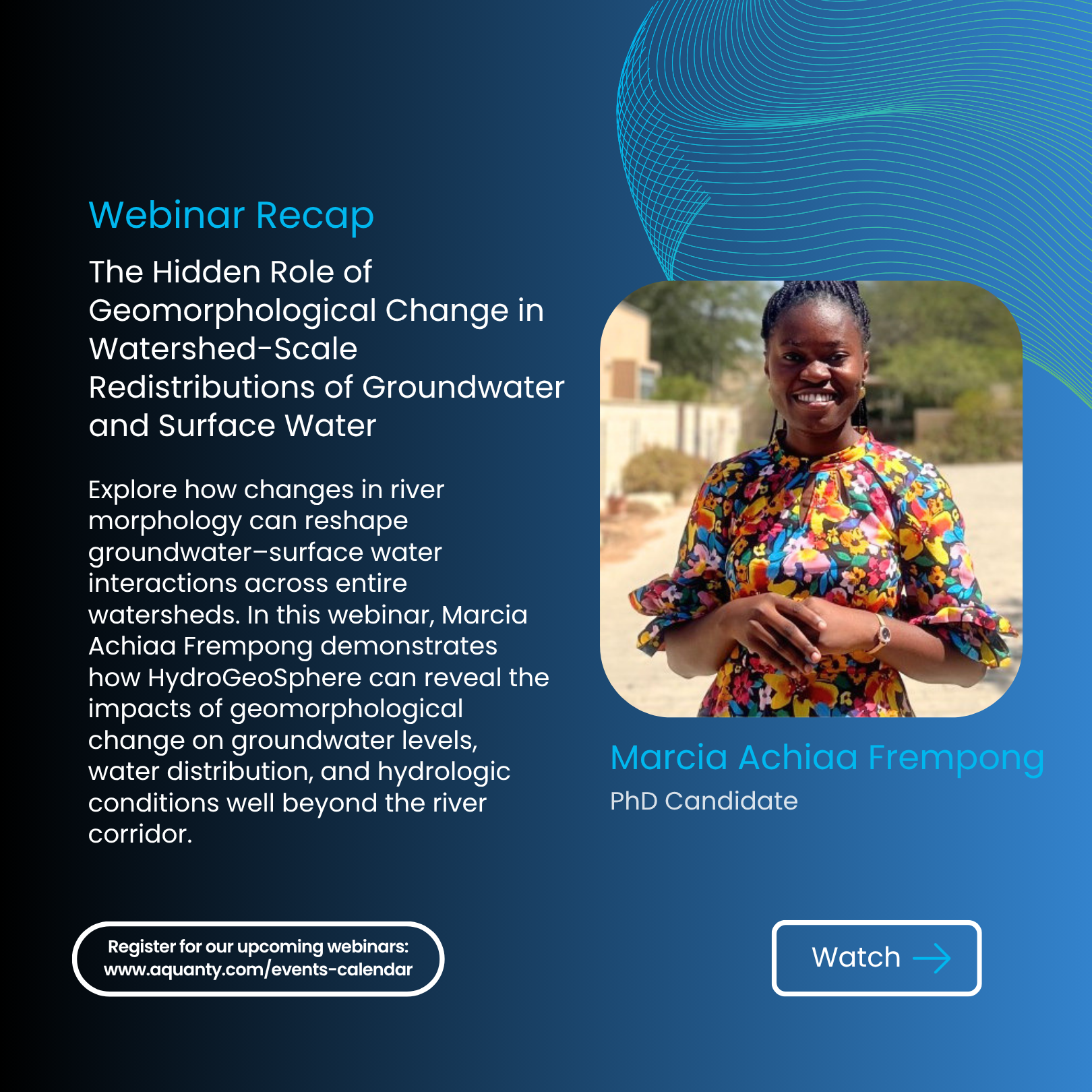
The Hidden Role of Geomorphological Change in Watershed-Scale Redistributions of Groundwater and Surface Water - Aquanty Webinar
We’re pleased to share the recording of our recent webinar, The Hidden Role of Geomorphological Change in Watershed-Scale Redistributions of Groundwater and Surface Water. This session, presented by Marcia Achiaa Frempong, PhD candidate at the University of Tennessee, Knoxville, explores how changes in watershed geomorphology can influence groundwater–surface water interactions and redistribute water across landscapes over time.

Hydraulic Mixing Cell (HMC) Training Session in HydroGeoSphere - Aquanty Webinar
We’re pleased to share the recording of our recent Hydraulic Mixing Cell (HMC) Training Session in HydroGeoSphere. Presented by Arghavan Tafvizi, HydroGeoSphere Specialist at Aquanty Inc., this practical session provides a comprehensive introduction to the Hydraulic Mixing Cell workflow and its application for analyzing surface water–groundwater interactions in integrated hydrologic models.

Using a Hydraulic Mixing‑Cell to Characterize Surface Water – Groundwater Interactions in Snow‑Dominated Catchments - Aquanty Webinar
We’re pleased to share the recording of our recent webinar, Using a Hydraulic Mixing-Cell to Characterize Surface Water–Groundwater Interactions in Snow-Dominated Catchments. This session, presented by Benjamin Frot, PhD Candidate at Laval University, explores how integrated hydrologic modelling and innovative post-processing techniques can improve our understanding of groundwater contributions to streamflow, water age, and climate change impacts in snow-dominated watersheds.

Flee From Parsimony: Escaping the Boundary Condition Paradox in Groundwater Modelling - Aquanty Webinar
We’re pleased to share the recording of our recent webinar, Tracking Surface Water and Groundwater Contributions to Flooding in an Alluvial Aquifer. This session, presented by Dr. Michael Callaghan, Senior Applications Engineer at Aquanty Inc., explores how integrated hydrologic modelling can improve understanding of groundwater flooding risks— particularly during major flood events.
Focusing on the June 2013 flooding in southern Alberta, the webinar demonstrates how groundwater flow within alluvial aquifers can contribute to infrastructure damage, even when overland flood defences are in place. Using HydroGeoSphere and its Hydraulic Mixing Cell (HMC) approach, the study tracks the dynamic contributions of surface water and groundwater throughout a flood event, offering new insight into subsurface flood mechanisms and system behaviour.

HMC Tracking with HGS: Tracking Surface Water and Groundwater Contributions to Flooding in an Alluvial Aquifer - Aquanty Webinar
We’re pleased to share the recording of our recent webinar, Tracking Surface Water and Groundwater Contributions to Flooding in an Alluvial Aquifer. This session, presented by Dr. Michael Callaghan, Senior Applications Engineer at Aquanty Inc., explores how integrated hydrologic modelling can improve understanding of groundwater flooding risks— particularly during major flood events.
Focusing on the June 2013 flooding in southern Alberta, the webinar demonstrates how groundwater flow within alluvial aquifers can contribute to infrastructure damage, even when overland flood defences are in place. Using HydroGeoSphere and its Hydraulic Mixing Cell (HMC) approach, the study tracks the dynamic contributions of surface water and groundwater throughout a flood event, offering new insight into subsurface flood mechanisms and system behaviour.

Advances in HydroGeoSphere (HGS) Over The Last Decade - Aquanty Webinar
We’re pleased to share the recording of our recent webinar exploring the evolution of HydroGeoSphere (HGS) — from its origins as an ambitious integrated hydrologic modelling experiment to a widely trusted, industry-leading platform for groundwater and surface water simulation.
Presented by Dr. Hyoun-Tae Hwang, Director of HydroGeoSphere at Aquanty Inc., this session offers a comprehensive retrospective on the development of HGS since its initial launch in 2002 and its continued advancement under Aquanty since 2012. The webinar highlights key milestones, technical innovations, and the expanding capabilities that have positioned HGS at the forefront of hydrological modelling.

CWRA SK Branch Webinar: Advancing Water Intelligence: Real-Time Forecasting and Data Integration with HydroClimateSight and Canada1Water
We’re pleased to share the recording of the recent CWRA Saskatchewan Branch webinar, Advancing Water Intelligence: Real-Time Forecasting and Data Integration with HydroClimateSight and Canada1Water. Presented by Jag Phagura of Aquanty Inc., this session explores how integrated forecasting tools and national-scale datasets are helping improve modern water resource management across Canada.

HydroGeoSphere Development 2025: The Year in Review - Aquanty Webinar
We’re pleased to share the recording of our webinar ‘HydroGeoSphere Development 2025: The Year in Review’. This session, presented by Dr. Killian Miller, Numerical Analysis Specialist at Aquanty, looks back at a year of major advancements to the HydroGeoSphere platform— highlighting new features, performance improvements, and key structural updates across the HGS ecosystem.

Introducing hgs2vtu for HGS model post-processing - Aquanty Webinar
We’re pleased to share the recording of our recent webinar introducing hgs2vtu.exe, the powerful new post-processing utility designed to modernize and streamline visualization of HydroGeoSphere (HGS) model outputs.