
HydroGeoSphere Research Project Featured in Scienmag.
“The modelling framework itself represents a methodological leap. HydroGeoSphere solves surface and subsurface flow simultaneously within a single implicit system, coupling three-dimensional variably saturated groundwater flow described by the Richards equation with two-dimensional overland and channel flow governed by the diffusion-wave approximation of the Saint-Venant equations.”
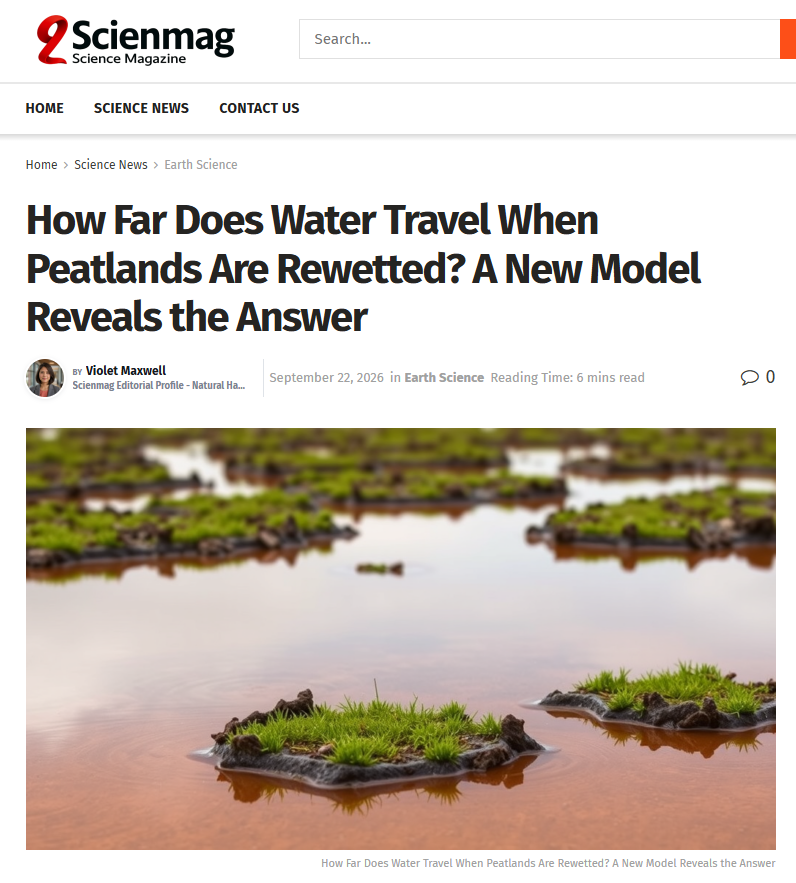
We’re pleased to share that recent HydroGeoSphere (HGS) research has been featured in Scienmag. The article, “How Far Does Water Travel When Peatlands Are Rewetted? A New Model Reveals the Answer.” examines how different peatland restoration interventions influence water-table recovery across a boreal fen in northern Finland, based on research by Omar Ashraf Nimr, Hannu Marttila, Okke Batelaan, Daniel Partington, and Pertti Ala-Aho.
The research paper addresses an important question for peatland restoration: when drainage ditches are blocked or filled, how far do the hydrological benefits of rewetting actually extend? Restoration assessments often rely on individual monitoring wells, making it difficult to determine how interventions affect groundwater conditions across an entire peatland. The researchers addressed this challenge using a fully integrated, three-dimensional HydroGeoSphere model of the Matorovasuo peatland and its surrounding headwater catchment.
HydroGeoSphere enabled the researchers to simulate coupled surface–subsurface flow across both drained and restored configurations while incorporating rainfall, snowmelt, evapotranspiration, peat stratigraphy, groundwater observations, and restoration structures. The model represented the effects of ditch infilling and damming across the peatland, allowing the researchers to examine not only water-table changes immediately surrounding restoration structures but also how those effects propagate laterally across the wider landscape.
The Scienmag feature highlights how hydrological modelling with HydroGeoSphere can provide researchers with a more complete understanding of where, when, and how far rewetting interventions may influence peatland hydrology. Rather than assuming restoration benefits are limited to the immediate vicinity of blocked ditches, the HydroGeoSphere simulations demonstrate that restoring hydrological connectivity can produce substantial far-field effects across the peatland landscape.
We originally highlighted this research on our blog, including more detail on the HydroGeoSphere modelling approach, groundwater response and implications for peatland restoration planning and climate mitigation.
The recognition of this work by Scienmag further showcases how fully integrated surface–subsurface modelling with HydroGeoSphere can help translate complex hydrological processes into practical insights for ecosystem restoration. By quantifying how restoration effects propagate beyond individual interventions, this research provides a framework for designing more effective peatland rewetting strategies and improving the long-term recovery of these important carbon-rich ecosystems.