
HGS RESEARCH HIGHLIGHT – Climate Change Alters Post-Surge Recovery of Coastal Aquifers

Tajima, S., Therrien, R., & Brunner, P. (2026). Climate Change Alters Post‐Surge Recovery of Coastal Aquifers. Water Resources Research, 62(3). https://doi.org/10.1029/2025wr042142
“This framework offers a straightforward tool for the preliminary assessment of climate-change impacts on coastal groundwater systems, particularly for small islands with limited and vulnerable freshwater resources, thereby supporting proactive water security strategies against climate change.”
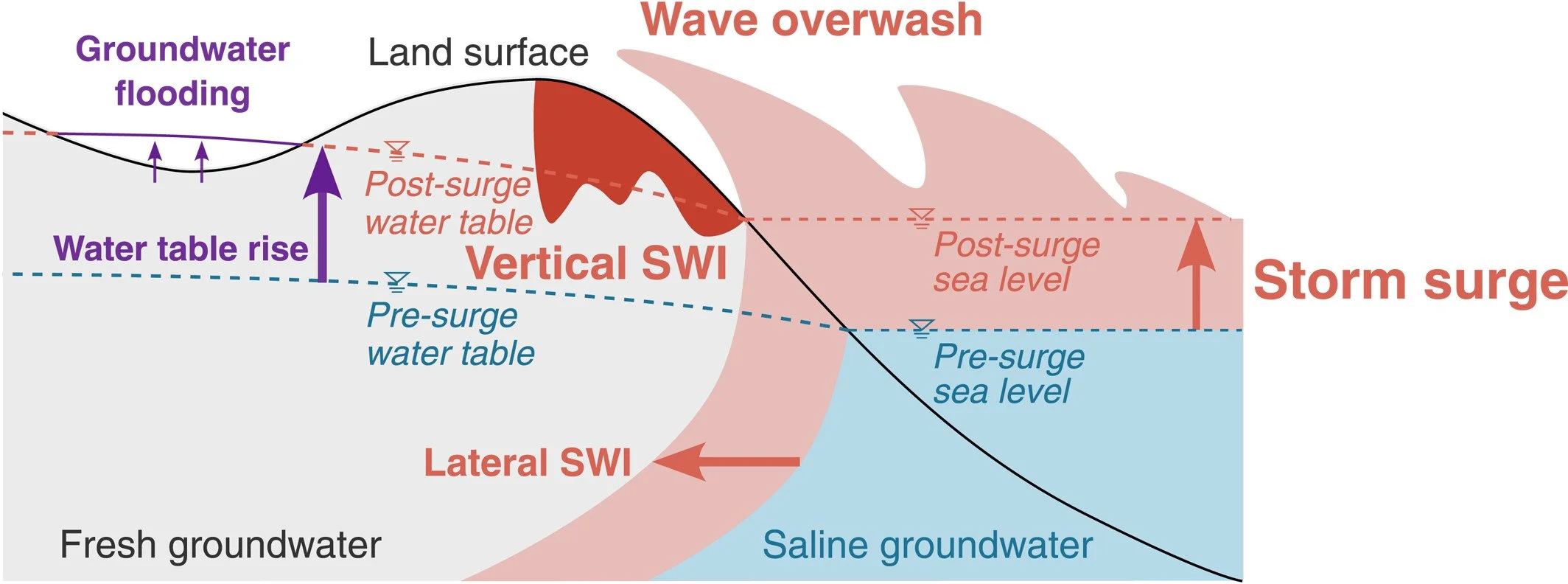
Fig. 1. Schematic of storm–surge impacts on the coastal surface–subsurface continuum. Rising sea levels during a storm surge often lead to wave overwash, resulting in seawater inundation of the land surface and vertical seawater intrusion (SWI) into the subsurface. The elevated sea level also increases the hydraulic head in the sea, driving landward lateral SWI. In addition, the groundwater table rises in response to the higher sea head, sometimes causing groundwater flooding.
CLICK HERE TO READ THE ARTICLE.
This publication co-authored by Satoshi Tajima, René Therrien and Philip Brunner investigates how climate change influences the recovery of coastal aquifers following storm surge events. This study leverages HydroGeoSphere (HGS) to simulate coupled groundwater flow and variable-density salt transport, addressing long-standing challenges in understanding how coastal aquifers respond to storm-driven seawater intrusion and how recovery dynamics may change under future climatic conditions.
Traditional studies of coastal aquifer salinization often focus on the immediate impacts of storm surges or long-term sea-level rise, while treating post-surge freshwater recovery as a relatively simple flushing process. However, the recovery of coastal groundwater systems involves complex interactions between density-driven flow, freshwater recharge, and subsurface heterogeneity. By using HGS to simulate fully integrated surface–subsurface hydrologic processes together with salt transport, this research provides a physically consistent framework to evaluate how storm surge intrusion propagates through aquifers and how freshwater systems gradually recover.
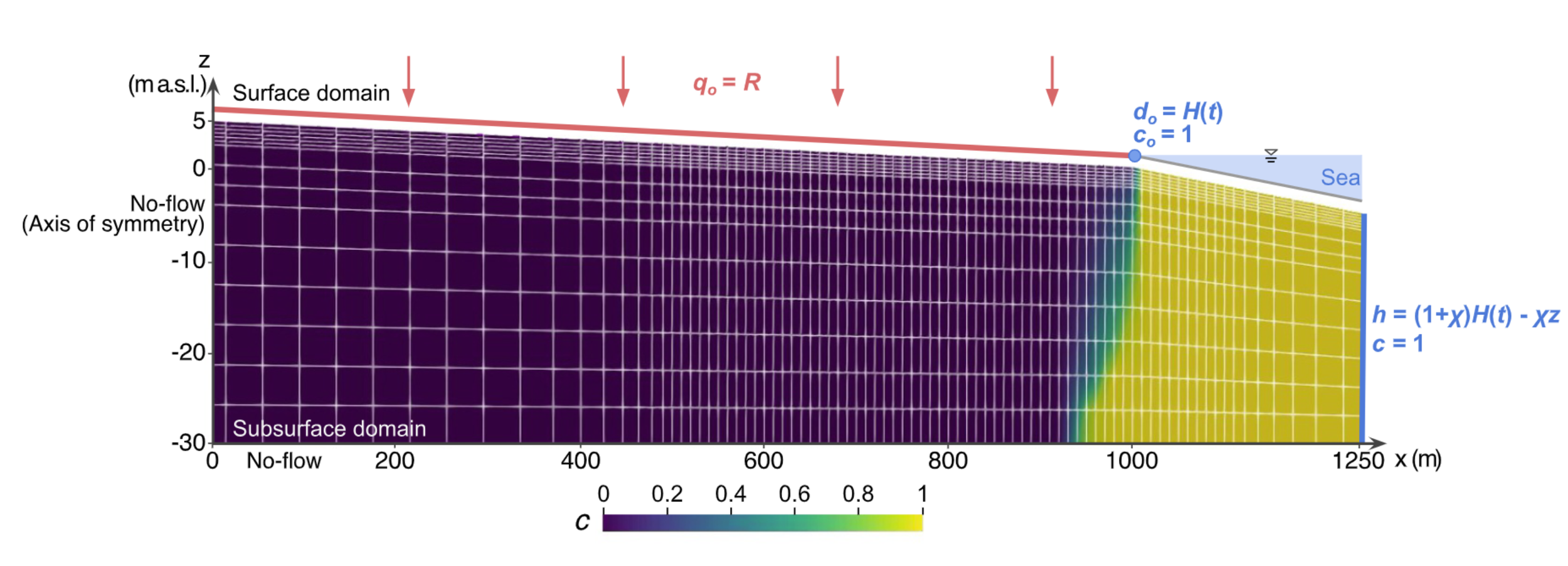
Fig. 2. Model domain and boundary conditions for baseline case (L = 1000 m), with quasi‐steady‐state salinitydistribution for baseline value of hydraulic conductivity (K = 10 m d-1). Vertical exaggeration x 10.
The study applied the HGS model to a coastal aquifer system subjected to storm surge events under both present-day and future climate scenarios. Simulations showed that storm surges can rapidly introduce saline water into coastal aquifers, generating density-driven circulation that persists long after surface waters recede. Recovery of freshwater conditions was strongly controlled by recharge rates, aquifer permeability, and the extent of the initial saltwater intrusion. Under projected climate scenarios, reduced recharge and changing precipitation patterns significantly slowed aquifer recovery times.
Key findings demonstrated that climate change can substantially alter post-surge recovery dynamics by modifying the hydrologic conditions that flush saline water from aquifers. In many scenarios, recovery times increased considerably, indicating that coastal groundwater systems may remain vulnerable to salinization for longer periods following extreme coastal flooding events.
HydroGeoSphere proved essential in enabling this work due to its ability to simulate three-dimensional groundwater flow and density-dependent salt transport within a single physics-based modelling framework. By resolving the interactions between recharge, buoyancy-driven flow, and subsurface heterogeneity, HGS allowed the researchers to quantify how storm surge intrusion evolves and dissipates within coastal aquifers over time.
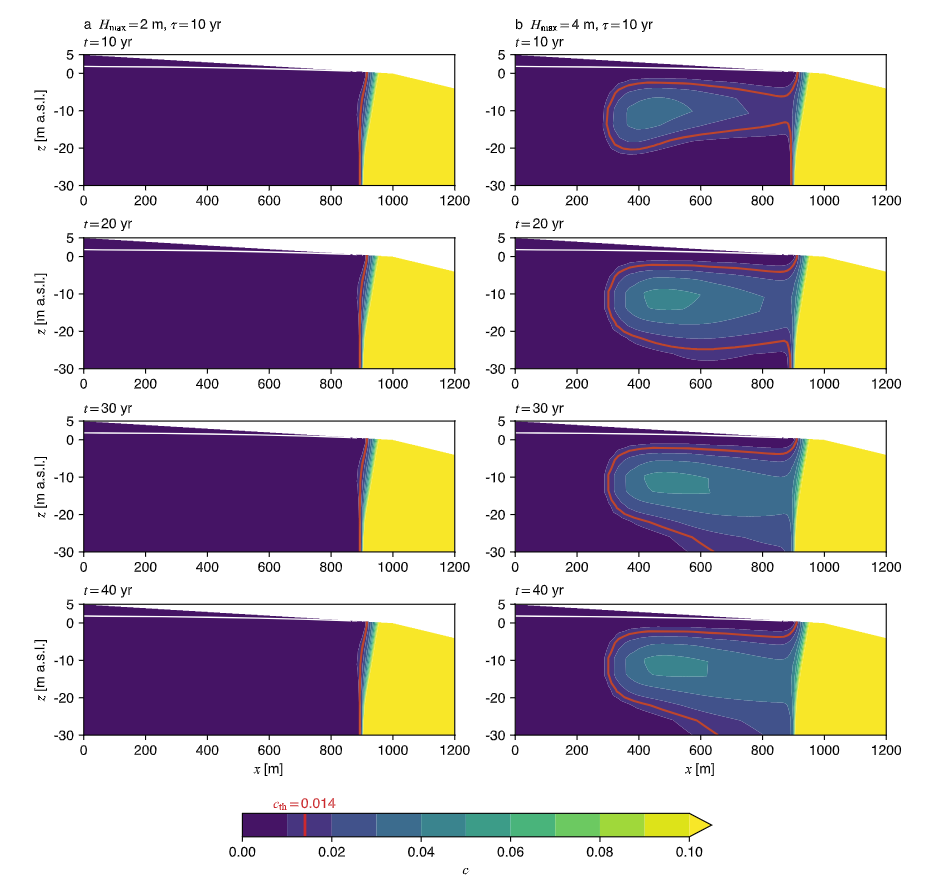
Fig. 6. Snapshots of salinity distributions for (a) baseline scenario with Hmax = 2 m and (b) scenario with higher Hmax = 4 m. Values of other parameters are identical: K = 10 m d-1 and L = 1000 m. White lines denote water tables, and red lines are isolines at c = 0.014 , which corresponds to 0.5 mg L-1 (Environmental Protection Agency, 2002) if the seawater concentration is 35 mg L-1. Note that salinity contours are different from those in Fig. 2.
This research provides critical insights for coastal hydrogeology and groundwater management, demonstrating that advanced modelling approaches like HydroGeoSphere are essential for assessing the long-term impacts of extreme coastal flooding under climate change. By linking storm surge dynamics with aquifer recovery processes, the study helps inform strategies to protect freshwater resources in vulnerable coastal environments.
Abstract:
Climate change is expected to increase storm-surge intensity while reducing its frequency, posing complex challenges for the recovery of coastal aquifers subject to recurrent wave overwash events. This study quantifies the combined effects of these opposing trends using surface–subsurface integrated numerical simulations of a generalized island aquifer across 12 scenarios with varying storm-surge frequency and intensity. Here, we show that two distinct long-term regimes emerge: (a) full recovery, where the aquifer returns to pre-surge conditions if storm intensity and frequency remain below critical thresholds, and (b) shifted equilibrium, characterized by persistent salt accumulation and depleted fresh groundwater availability if these thresholds are exceeded. Higher hydraulic conductivity and smaller island width exacerbate salt accumulation, the former by increasing the salt load introduced during each storm-surge event, and the latter by decelerating subsequent flushing. The transition between recovery and shifted-equilibrium regimes can be represented with a dimensionless number, E, that integrates the effect of storm-surge intensity and frequency on salt load. In a shifted equilibrium regime, the excess salt load at new dynamic equilibria is effectively approximated by linear functions of E. This framework offers a straightforward tool for the preliminary assessment of climate-change impacts on coastal groundwater systems, particularly for small islands with limited and vulnerable freshwater resources, thereby supporting proactive water security strategies against climate change.