
HGS RESEARCH HIGHLIGHT – Numerical simulation of geothermal energy transfer beneath exothermic waste rock piles

Raymond, J., Therrien, R., Gosselin, L., & Lefebvre, R. (2011). Numerical simulation of geothermal energy transfer beneath exothermic waste rock piles. HVAC&R Research, 17(6), 1115–1128. https://doi.org/10.1080/10789669.2011.589747
“HydroGeoSphere was developed to simulate subsurface fluid flow and mass transfer in the context of hydrogeological applications, but it can also be used to simulate ground coupled heat pump systems, thus helping to bridge the gap between mechanical and geological engineers”
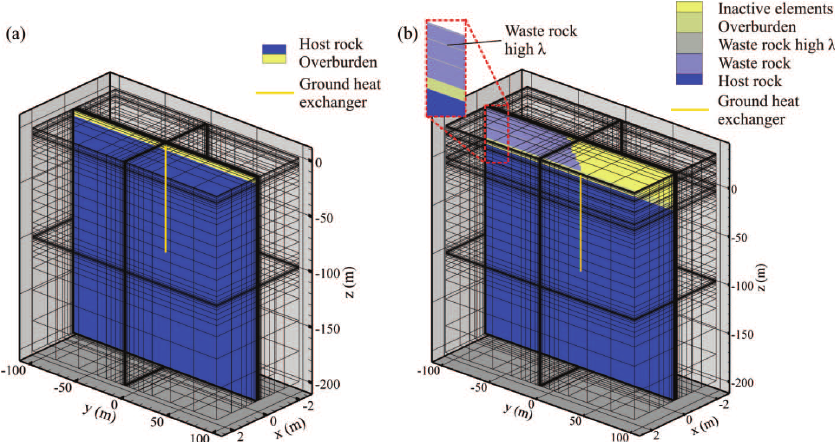
Fig. 2. Finite-element mesh used for a system: (a) without a waste rock pile and (b) with a waste rock pile. The vertical cross- section shows the model sub-domains, the location of the ground heat exchanger, and the position of inactive elements.
This publication, co-authored by Jasmin Raymond, René Therrien, Louis Gosselin, and René Lefebvre, which investigates how geothermal energy can be harnessed beneath exothermic waste rock piles to improve the performance of ground-coupled heat pump systems. This study leverages HydroGeoSphere (HGS) to simulate coupled subsurface fluid flow and heat transfer, addressing long-standing challenges in quantifying how enhanced subsurface temperatures generated by sulfide mineral oxidation can reduce the required length and number of ground heat exchangers.
Traditional design of ground-coupled heat pump systems often assumes relatively low and uniform subsurface temperatures, which can drive up installation costs by requiring longer boreholes and more exchangers to meet heating loads. In mining environments, however, oxidation of sulfide minerals within waste rock piles produces significant heat that elevates subsurface temperatures for decades. By using HGS to represent subsurface heterogeneity, geothermal gradients, and internal heat generation, this research moves beyond analytical line-source approaches to provide a physically consistent representation of heat transport in complex geological settings.
The study applied the HGS model to the South Dump waste rock pile at the Doyon Mine in Abitibi, Québec, simulating heat exchanger performance under multiple installation scenarios, including systems located outside the pile, at its toe, and beneath the waste rock. Results showed that systems positioned in the waste rock environment maintained higher minimum outlet temperatures and could operate with substantially fewer boreholes. Depending on location, the required number of boreholes was reduced by 15% to 46% compared to an equivalent system in undisturbed ground, while still meeting design temperature thresholds.
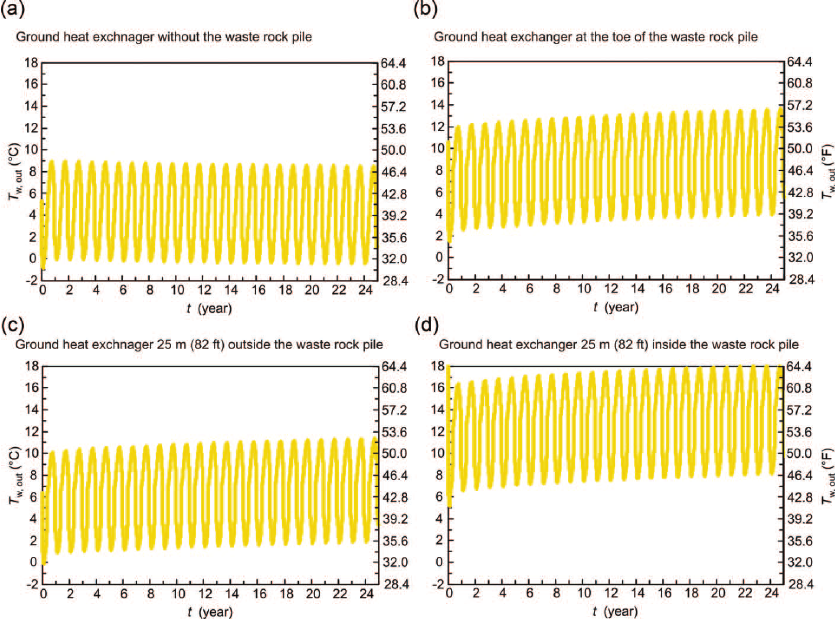
Fig. 8. Simulated outlet temperature for a ground heat exchanger located in a subsurface: (a) without a waste pile, (b) at the toe of the waste pile, (c) 25 m (82.0 ft) away from the waste pile, and (d) 25 m (82.0 ft) inside the waste pile. The simulations conducted with a waste pile are for an un-remediated scenario. The building loads assigned to the exchanger are distributed over 13 boreholes.
Key findings demonstrated that the migration of heat generated by mineral oxidation not only improves system efficiency but also sustains performance over long-term operation. Simulations over a 25-year period showed that outlet temperatures remained stable or increased with time, even under scenarios where the waste rock pile was remediated to limit oxygen and water inflow. This highlights the robustness of geothermal energy extraction in dynamic mining environments.
HydroGeoSphere proved essential in enabling this work due to its ability to simulate three-dimensional groundwater flow and heat transfer through heterogeneous materials, explicitly accounting for conduction, convection, and mechanical heat dispersion. By resolving how heat moves through layered waste rock, overburden, and host rock, HGS provided the physical basis to evaluate optimal exchanger placement and long-term energy performance.
This research provides critical insights for geothermal energy development and sustainable mining practices, showing that advanced, physics-based modelling approaches like HydroGeoSphere can unlock non-traditional geothermal resources. By demonstrating the feasibility of extracting energy from exothermic waste rock piles, the study paves the way for more efficient heating and cooling solutions for mine sites and nearby communities.
Abstract:
The installation of a ground coupled heat pump system can be expensive because it requires the drilling of boreholes to install ground heat exchangers. The cost of a system can be reduced by decreasing the total heat exchanger length or the number of boreholes, which depends, among other factors, on the ambient subsurface temperature. Systems designed according to heating loads therefore require fewer heat exchangers for higher subsurface temperatures. At open pit mines, where waste rock is accumulated in piles, exothermic oxidation of sulfide minerals within the piles can increase subsurface temperatures. To investigate the potential reduction in borehole length resulting from increased subsurface temperatures, heat transfer associated to a vertical ground heat exchanger installed beneath a waste pile was simulated with a numerical model. The physical characteristics of the pile are based on those of the South Dump waste rock pile of the Doyon Mine in Abitibi, Québec, Canada. Optimization of the heating loads assigned to the exchanger shows that the borehole length required for a given building can be reduced by 15% to 46%, depending on the location of the system relative to the waste rock pile.