
HGS RESEARCH HIGHLIGHT – Three‐Dimensional Geostatistical Inverse Analyses of Transient Head and Temperature Data From a Long‐Term Heat Tracer Test

Ning, Z., Nakashima, T., Inaba, K., Shimizu, T., Hwang, H., & Illman, W. A. (2026). Three‐Dimensional Geostatistical Inverse Analyses of Transient Head and Temperature Data From a Long‐Term Heat Tracer Test. Water Resources Research, 62(2). https://doi.org/10.1029/2025wr041599
“To analyze the 2015 HTT, we utilized a 3D geostatistical inverse modeling approach based on the pilot point method (de Marsily, 1984). The inversion is achieved by coupling a series of programs: (a) HGS, the forward simulator (Aquanty Inc, 2023); (b) PEST, the model-independent parameter estimation package (Doherty, 2005); (c) Parameter List Processor (PLPROC) implemented in the Groundwater Data Utilities (Doherty, 2008); and (d) R Statistical Software (R Core Team, 2023).”
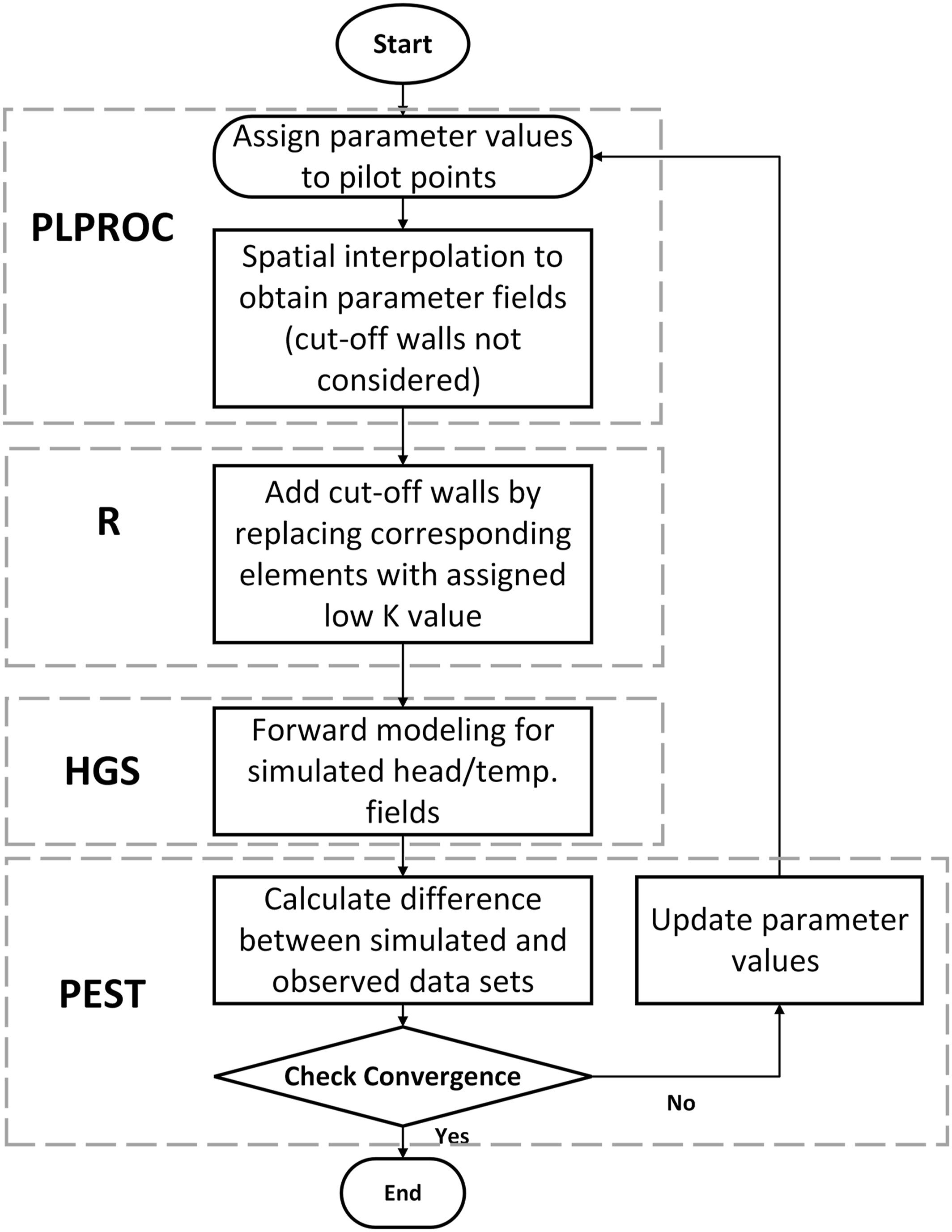
Fig. 3. The general framework of geostatistical inverse modeling using the pilot point method in this study.
We’re pleased to highlight this staff research highlighted which investigates how three-dimensional geostatistical inverse modelling can improve characterization of subsurface heterogeneity in groundwater systems. This study leverages HydroGeoSphere (HGS) to simulate fully coupled groundwater flow and transport processes within a stochastic inversion framework, addressing long-standing challenges in estimating spatially distributed hydraulic conductivity fields from limited observational data.
Traditional inverse modelling approaches often rely on simplified parameterizations or two-dimensional representations that cannot fully capture the spatial variability of subsurface properties. While these methods can reproduce observed hydraulic heads, they frequently underestimate uncertainty and fail to resolve complex flow structures. By integrating HGS within a three-dimensional geostatistical inversion workflow, this research enables physically consistent simulation of groundwater flow responses to heterogeneous conductivity distributions, improving the reliability of parameter estimation.
The study applied this approach to synthetic aquifer systems with complex hydraulic conductivity variability, using hydraulic head observations to constrain inverse solutions. Results demonstrated that the three-dimensional inversion framework successfully reconstructed spatial patterns of subsurface heterogeneity while preserving realistic flow dynamics. Compared with traditional inversion strategies, the coupled modelling approach produced improved estimates of hydraulic conductivity fields and reduced uncertainty in predicted groundwater flow behavior.
Key findings showed that incorporating fully distributed flow simulations within the inversion process significantly enhanced the identification of subsurface structure and reduced ambiguity in parameter estimation. The results also highlighted how uncertainty in conductivity fields propagates through groundwater flow predictions, emphasizing the importance of physically based modelling when interpreting inverse solutions in heterogeneous environments.
HydroGeoSphere proved essential in enabling this work due to its ability to simulate three-dimensional groundwater flow across heterogeneous domains within a flexible finite-element framework. By coupling geostatistical inversion with physically based flow simulation, HGS allowed the researchers to evaluate how spatial variability influences hydraulic responses and parameter uncertainty throughout the aquifer system.
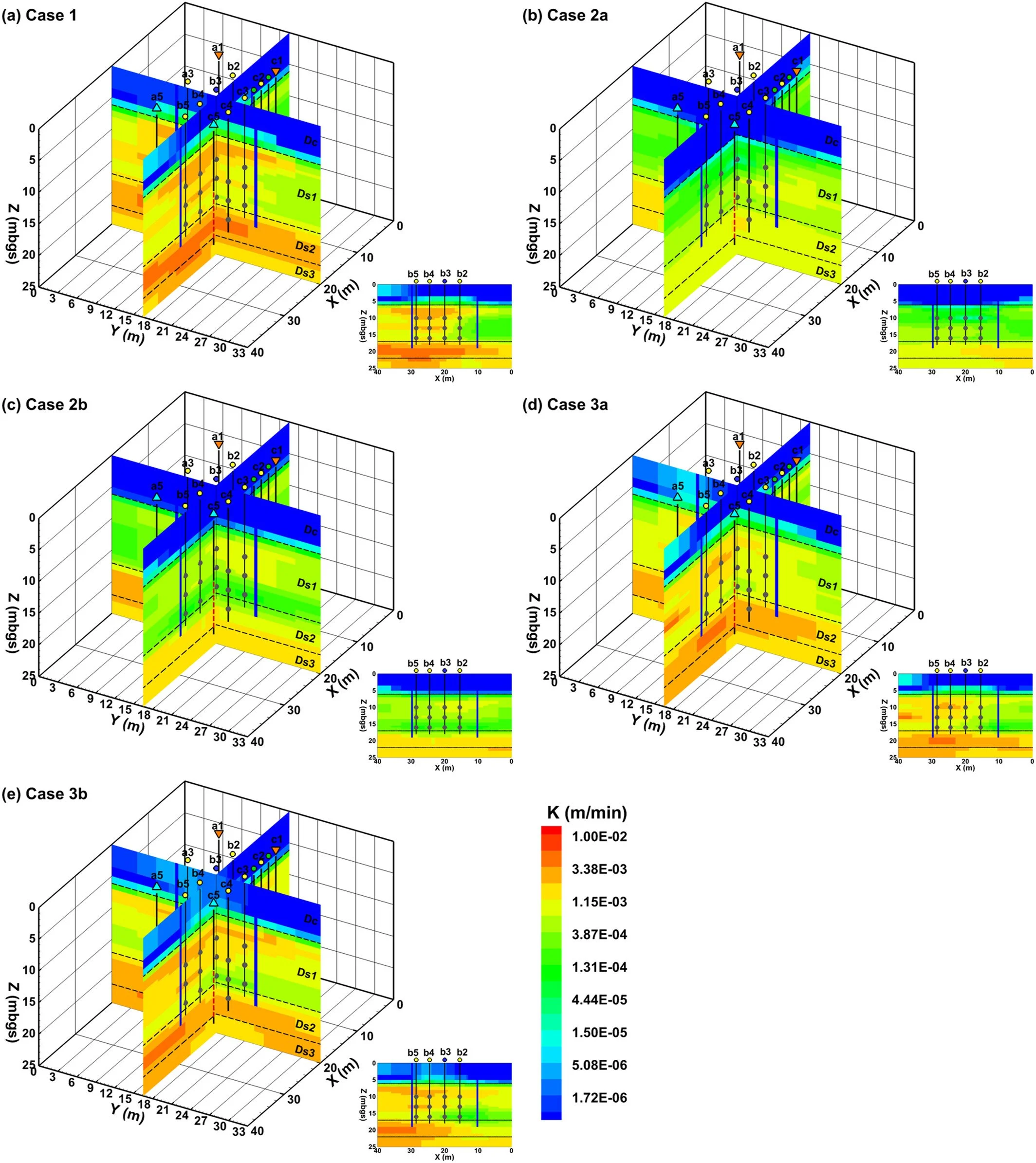
Fig. 5. Estimated K fields from inverse modeling of 2015 HTT for Cases: (a) 1; (b) 2a; (c) 2b; (d) 3a; (e) 3b. The cross section along Y = 16.5 m is included as well.
This research provides critical insights for groundwater characterization and uncertainty quantification, demonstrating that advanced modelling approaches like HydroGeoSphere are essential for improving subsurface parameter estimation in complex geological settings. By integrating geostatistical inversion with fully distributed flow simulation, the study paves the way for more reliable predictions of groundwater movement and resource availability.
Abstract:
Improving the accuracy of subsurface heterogeneity characterization remains a key component in better understanding groundwater flow and contaminant transport. Heat tracer tests can provide temperature measurements, in addition to head data, that can be used for mapping heterogeneity. Here, the performance of head and temperature data in characterizing the hydraulic conductivity (K) distribution is investigated with a three-dimensional highly parameterized model using the pilot point method. The performance results are evaluated qualitatively and quantitatively in various aspects, including K fields comparison, head and temperature matches for both model calibration and validation, as well as through identifiability and sensitivity analyses. Results of this study reveal that: (a) K fields obtained by inverting head data show finer details of heterogeneity, while small scale heterogeneity is smoothed when inverting temperature data; (b) combination of heat and temperature data improves the prediction of heat tracer tests; (c) increasing data density yields more heterogeneity information and further improves prediction performance; and (d) identifiability and sensitivity analyses suggest that head and temperature data contain nonredundant information of K heterogeneity. These results jointly suggest that the integration of transient head and temperature data shows promising potential in improving the delineation of subsurface K distribution and obtaining reliable predictions of head responses and heat plume migration.