
HGS RESEARCH HIGHLIGHT – Groundwater storage in Quaternary deposits and bedrock buffers the discharge response of a small alpine catchment to climate change
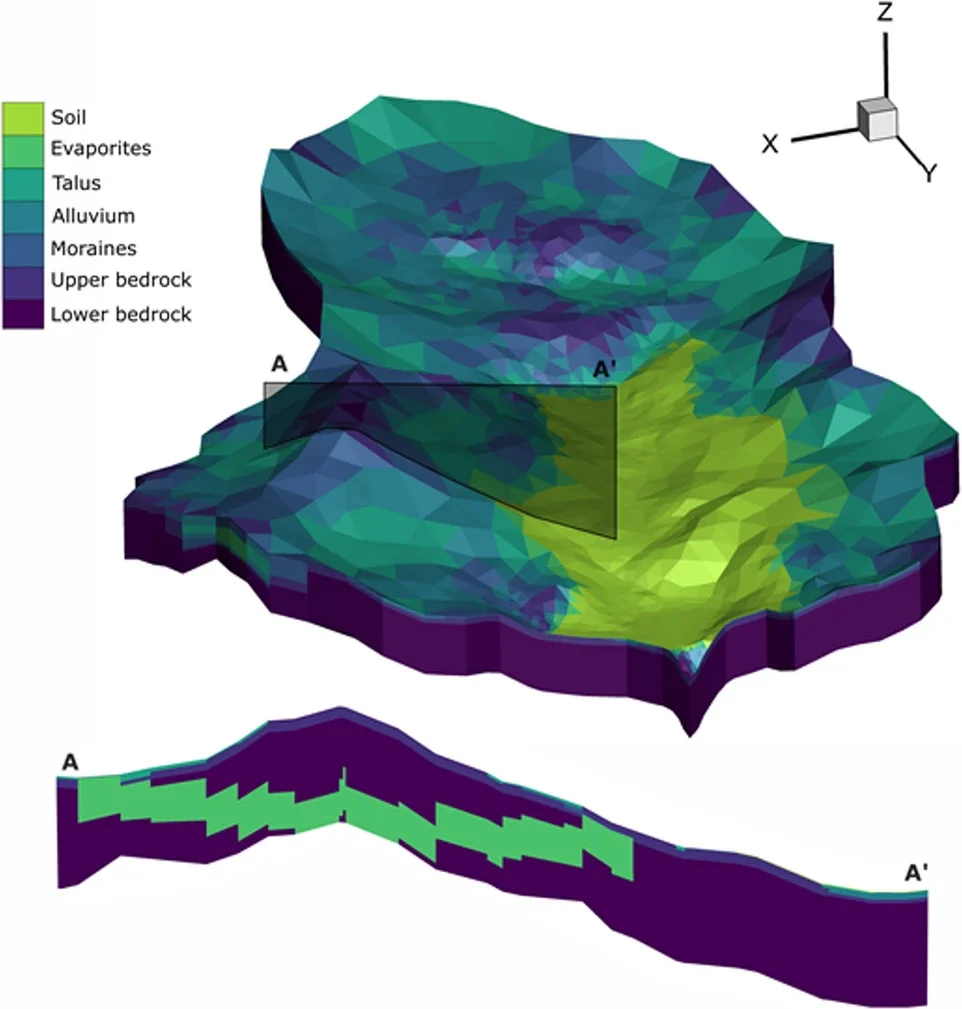
We’re pleased to highlight this publication by Marie Arnoux, Fabien Cochand, Philip Brunner, Bettina Schaefli, Adam Winstral, and Daniel Hunkeler, which uses HydroGeoSphere (HGS) to investigate how groundwater storage can buffer the effects of climate change on streamflow in snow-dominated alpine catchments. In particular, the study examines how groundwater stored within different geological formations influences future summer low flows as snow accumulation and melt patterns change.

HGS RESEARCH HIGHLIGHT – Three‐Dimensional Geostatistical Inverse Analyses of Transient Head and Temperature Data From a Long‐Term Heat Tracer Test
We’re pleased to highlight this staff research highlighted which investigates how three-dimensional geostatistical inverse modelling can improve characterization of subsurface heterogeneity in groundwater systems. This study leverages HydroGeoSphere (HGS) to simulate fully coupled groundwater flow and transport processes within a stochastic inversion framework, addressing long-standing challenges in estimating spatially distributed hydraulic conductivity fields from limited observational data.

HGS RESEARCH HIGHLIGHT – Using High-Resolution Data to Test Parameter Sensitivity of the Distributed Hydrological Model HydroGeoSphere
By integrating HydroGeoSphere in this study, the researchers demonstrate its versatility in accommodating high-resolution data and conducting sensitivity analyses across different spatial scales. Precipitation emerges as the most sensitive input data, significantly influencing total runoff and peak flow rates. Additionally, the study highlights the importance of spatially distributed land use parameterization in accurately simulating evapotranspiration components and patterns.