
HGS RESEARCH HIGHLIGHT – A hydraulic mixing-cell method to quantify the groundwater component of streamflow within spatially distributed fully integrated surface water–groundwater flow models

Partington, D., Brunner, P., Simmons, C. T., Therrien, R., Werner, A. D., Dandy, G. C., & Maier, H. R. (2011). A hydraulic mixing-cell method to quantify the groundwater component of streamflow within spatially distributed fully integrated surface water–groundwater flow models. Environmental Modelling & Software, 26(7), 886–898. https://doi.org/10.1016/j.envsoft.2011.02.007
“The nodal flow check tolerance in HGS, which is derived in McLaren et al. (2000), was utilised to ensure the nodal volumetric balances calculated in the HMC method were sufficient in preventing large cumulative errors.”
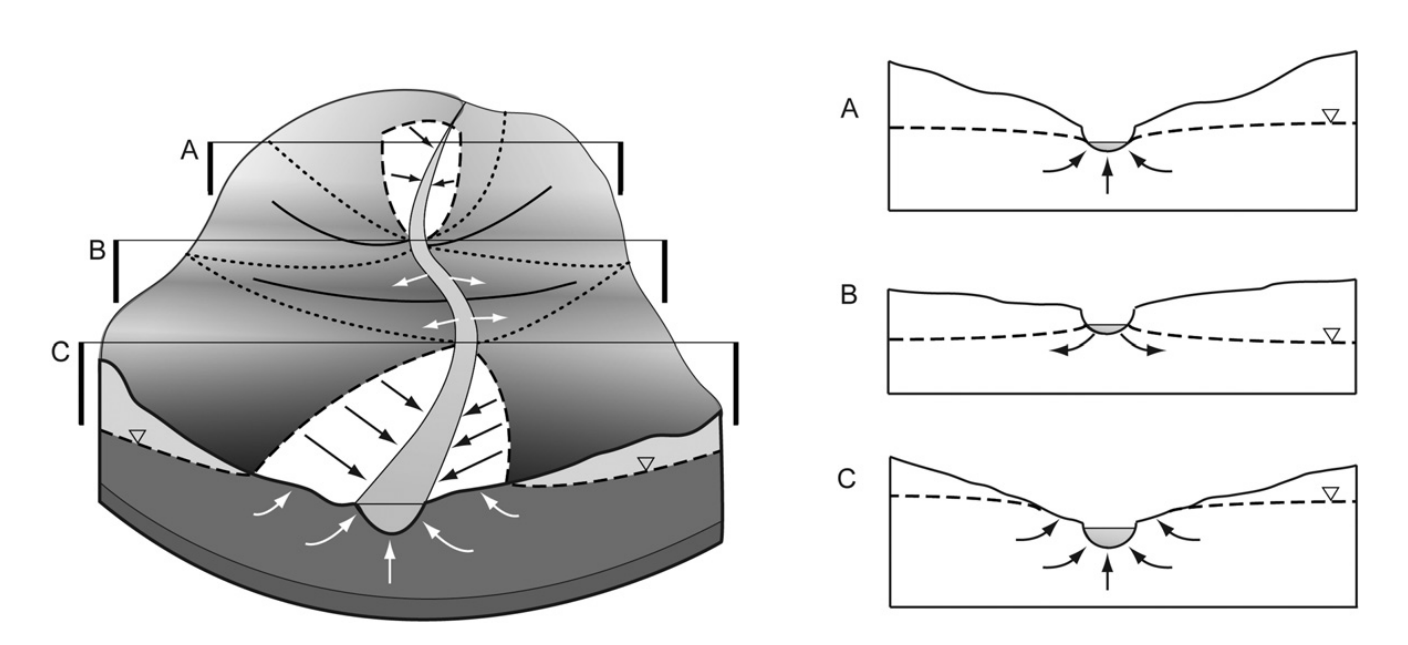
Fig. 1. Conceptual diagram of a surface water-groundwater catchment (left hand side) featuring different flow regimes (as illustrated in the right part of the figure). The white sections of the catchment adjacent to the stream represent the groundwater discharge upslope of the stream (return flow). The dashed lines on the right part of the figure represent the water table. The flow direction is towards the reader.
This research highlight co-authored by D. Partington, P. Brunner, C.T. Simmons, René Therrien, A.D. Werner, G.C. Dandy, and H.R. Maier, introduces a hydraulic mixing-cell (HMC) method to accurately quantify the groundwater component of streamflow within fully integrated surface–subsurface hydrologic models. This study leverages HydroGeoSphere (HGS) to address long-standing challenges in decomposing streamflow generation mechanisms without relying on tracer transport simulations or simplifying assumptions about groundwater discharge.
Traditional approaches for estimating groundwater contributions to streamflow often rely on summed exfiltration along stream reaches or tracer-based hydrograph separation. While commonly used, these methods fail to account for travel time delays, stream losses, and changing gaining–losing conditions, frequently leading to significant overestimation of groundwater contributions. By contrast, the HMC method uses only hydraulic information produced by fully integrated models like HGS, enabling direct extraction of groundwater contributions at any point along a stream network.
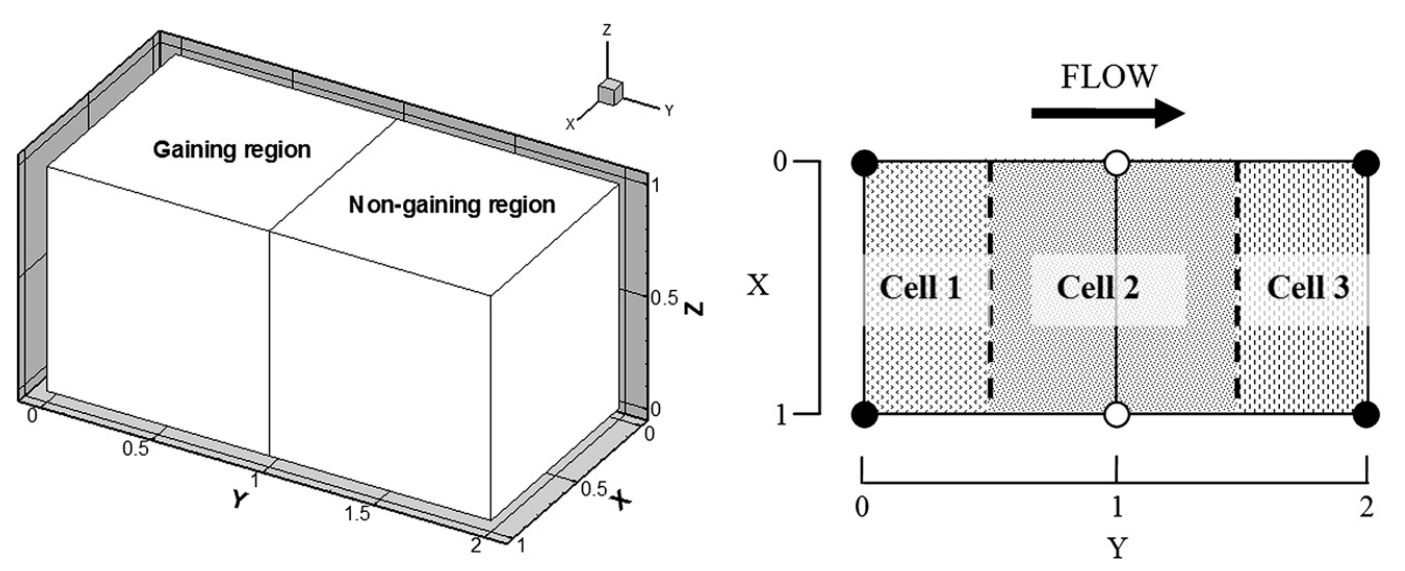
Fig 4. Test case 1: “two-region” model grid, and HMCs for HGS nodes in “two-region” model grid. In the right part of the figure the two nodes at y=0 belong to HMC 1, the two nodes at y=1 belong to HMC 2 and the nodes at y=2 belong to HMC 3.
The study developed and tested the HMC method using HydroGeoSphere simulations across two numerical experiments. The first test case verified mass conservation and numerical stability under controlled conditions, while the second applied the method to a highly transient catchment featuring rainfall events, groundwater pumping, and dynamically shifting gaining and losing stream sections. Results showed that the HMC method accurately tracked groundwater and rainfall contributions through time and space, revealing substantial discrepancies between true groundwater contributions and those estimated using summed exfiltration.
Key findings demonstrated that summed exfiltration can significantly overestimate the groundwater component of streamflow, particularly in catchments with long stream networks, internal losses, or strong temporal variability. In contrast, the HMC method correctly accounted for channel storage, streamflow travel times, and alternating flow regimes, providing a physically consistent decomposition of streamflow components directly from the hydraulic solution.
HydroGeoSphere proved essential in enabling this work due to its ability to simulate fully coupled surface and subsurface flow and to report spatially distributed exchange fluxes between domains. By integrating the HMC method directly into the HGS simulation framework, the study demonstrated how integrated hydrologic models can move beyond total streamflow prediction to provide mechanistic insight into streamflow generation processes.
This research provides critical insights for catchment hydrology and water resources management, showing that advanced, physics-based modelling approaches like HydroGeoSphere are essential for accurately quantifying groundwater contributions to streamflow. By overcoming the limitations of traditional separation techniques, the HMC method paves the way for more reliable interpretation of streamflow dynamics in complex and transient hydrologic systems.
Abstract:
The complexity of available hydrological models continues to increase, with fully integrated surface water–groundwater flow and transport models now available. Nevertheless, an accurate quantification of streamflow generation mechanisms within these models is not yet possible. For example, such models do not report the groundwater component of streamflow at a particular point along the stream. Instead, the groundwater component of streamflow is approximated either from tracer transport simulations or by the sum of exchange fluxes between the surface and the subsurface along the river. In this study, a hydraulic mixing-cell (HMC) method is developed and tested that allows to accurately determine the groundwater component of streamflow by using only the flow solution from fully integrated surface water–groundwater flow models. By using the HMC method, the groundwater component of streamflow can be extracted accurately at any point along a stream provided the subsurface/surface exchanges along the stream are calculated by the model. A key advantage of the HMC method is that only hydraulic information is used, thus the simulation of tracer transport is not required. Two numerical experiments are presented, the first to test the HMC method and the second to demonstrate that it quantifies the groundwater component of streamflow accurately.