
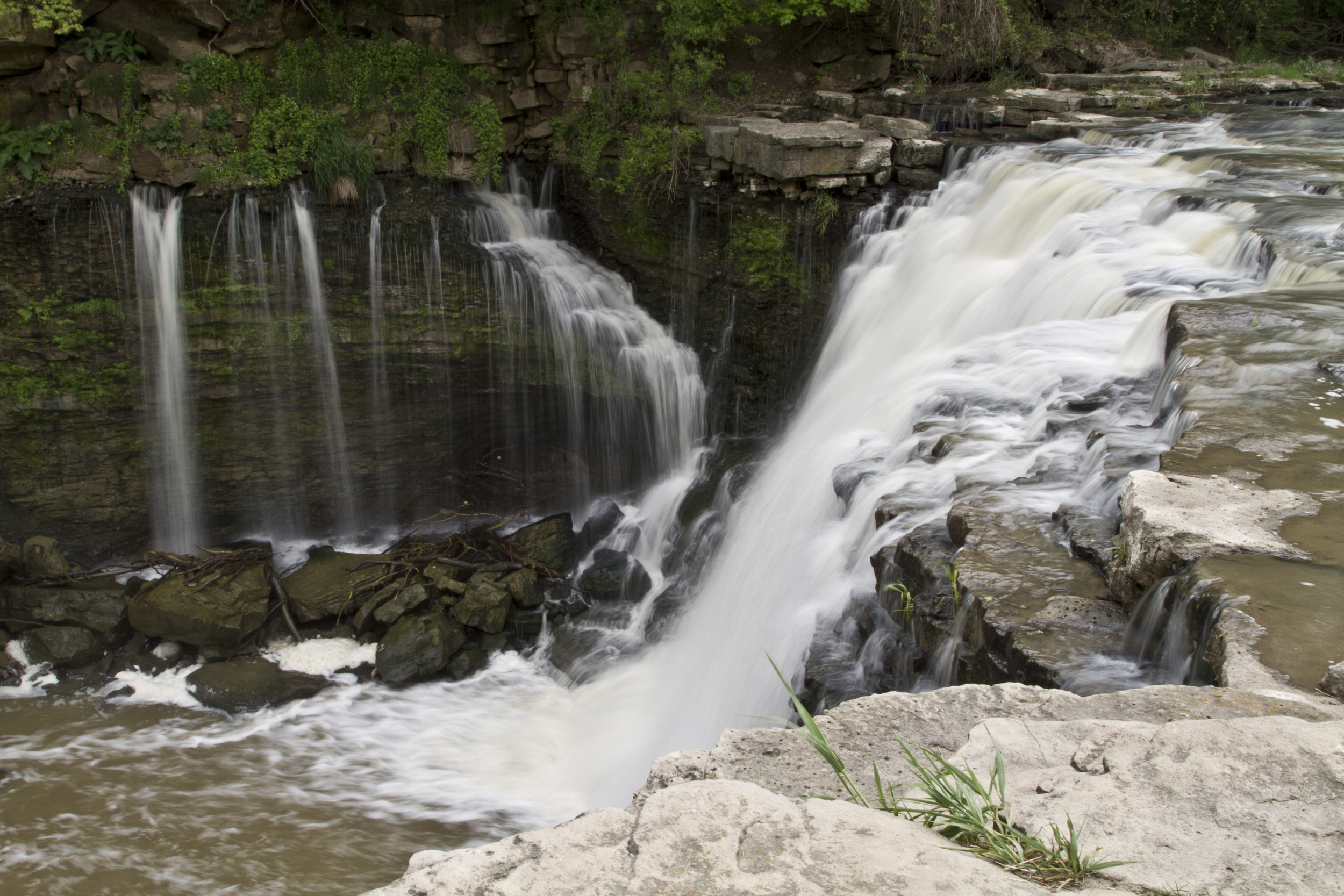
HGS RESEARCH HIGHLIGHT - Simulating Climate Change Impacts on Surface Water Resources within a Lake Affected Region using Regional Climate Projections
This study aims to assess the impact of climate change on water resources in a large watershed within the Laurentian Great Lakes region, using the fully‐integrated surface‐subsurface model HydroGeoSphere. The hydrologic model is forced with an ensemble of high‐resolution climate projections from the Weather Research and Forecasting model (WRF). The latter has been extended with an interactive lake model (FLake) to capture the effect of the Great Lakes on the regional climate. The WRF ensemble encompasses two different moist physics configurations at resolutions of 90km, 30km, and 10km, as well as four different initial and boundary conditions, so as to control for natural climate variability. The integrated hydrologic model is run with a representative seasonal cycle, which effectively controls natural climate variability, while remaining computationally tractable with a large integrated model.
HGS Research Highlight - Dual permeability modeling of tile drain management influences on hydrology and nutrient transport in macroporous soil
This post features a recent study by Frey et al., 2016 who used 2-dimensional dual permeability HydroGeoSphere models to simulate the flow and transport of liquid swine manure and rhodamine tracer application on a macroporous clay loam under controlled (CD) and free drainage (FD) tile management.
HGS Research Highlight - Coupled atmospheric, land surface, and subsurface modeling: Exploring water and energy feedbacks in three-dimensions
This post highlights the recent study by Davison et al. (2015) on the coupling of HGS to an Atmospheric Boundary Layer (ABL) model. Implementing the coupled HGS-ABL model the authors found ...
HGS Research Highlight - A simple iterative method for estimating evapotranspiration with integrated surface/subsurface models
This work presents an iterative, water balance based approach to estimate actual evapotranspiration (ET) with integrated surface/subsurface flow models. Traditionally, groundwater level fluctuation methods have been widely accepted and used for estimating ET and net groundwater recharge; however, in watersheds where interactions between surface and subsurface flow regimes are highly dynamic, the traditional method may be overly simplistic....