
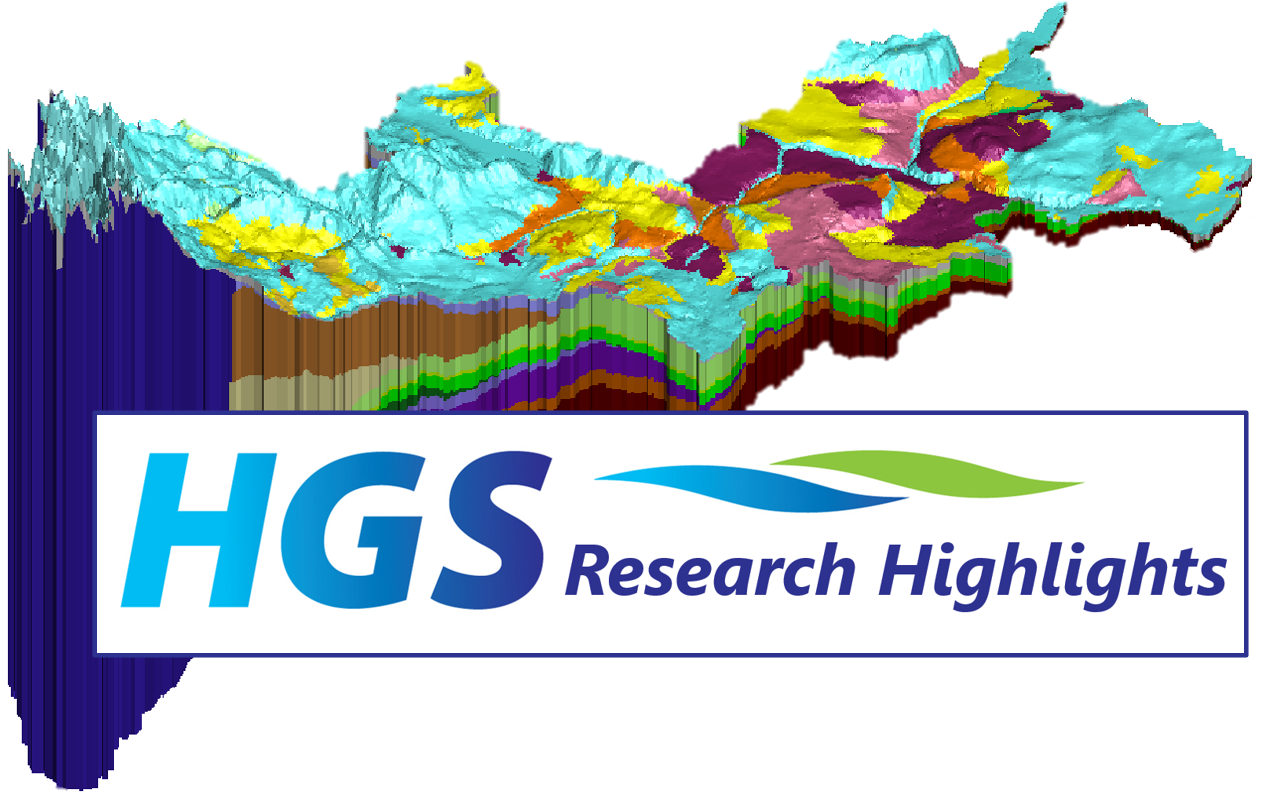
HGS RESEARCH HIGHLIGHT - Groundwater flow and age in topography-driven groundwater flow systems with geological barriers
The research examines how groundwater age and flow systems are influenced by topography and geological barriers, using numerical simulations to clarify the interaction between surface-driven flow and subsurface heterogeneity. Traditional models of topography-driven flow often assume homogeneous geologic conditions, which can obscure the role of stratigraphic variations in shaping groundwater movement and age distribution. This study offers a detailed exploration of how structural barriers— such as low-permeability formations— interrupt or redirect groundwater pathways and affect the spatial and temporal distribution of groundwater age.

Staff Research Highlight - Improving precision in regional scale numerical simulations of groundwater flow into underground openings
The study presents a novel numerical framework to improve the accuracy of regional-scale groundwater flow simulations into underground openings, such as tunnels and deep geological repositories. Traditionally, simulating groundwater inflows into engineered underground structures has involved significant simplifications, often treating tunnels as drain features or imposing boundary conditions that fail to fully capture the physical behavior of fluid flow around these voids. This research addresses those limitations by introducing a new numerical boundary condition to simulate groundwater flow into underground openings more accurately.

HGS RESEARCH HIGHLIGHT - Is the Water Balance of Your Waste Rock Pile Reliable? A framework for Improving Assessment of Water Inputs and Outputs for a Typical Storage Facility
This research focuses on understanding the dynamics of topography-driven groundwater flow systems using fully-coupled surface–subsurface hydrologic modelling. This study addresses long-standing challenges in representing nested flow systems by simulating interactions between climate, topography, and groundwater without relying on potentially unrealistic, static boundary conditions.
Staff Research Highlight - Quantifying the potential of using Soil Moisture Active Passive (SMAP) soil moisture variability to predict subsurface water dynamics
Aquanty staff investigate the potential for using near-surface soil moisture measurements from the Soil Moisture Active Passive (SMAP) satellite to predict subsurface soil moisture and groundwater storage dynamics. This research offers valuable insights into how satellite-based soil moisture data can inform large-scale hydrological modelling and support more effective water resource management.
Staff Research Highlight - Understanding topography-driven groundwater flow using fully-coupled surface-water and groundwater modeling
This research focuses on understanding the dynamics of topography-driven groundwater flow systems using fully-coupled surface–subsurface hydrologic modelling. This study addresses long-standing challenges in representing nested flow systems by simulating interactions between climate, topography, and groundwater without relying on potentially unrealistic, static boundary conditions.
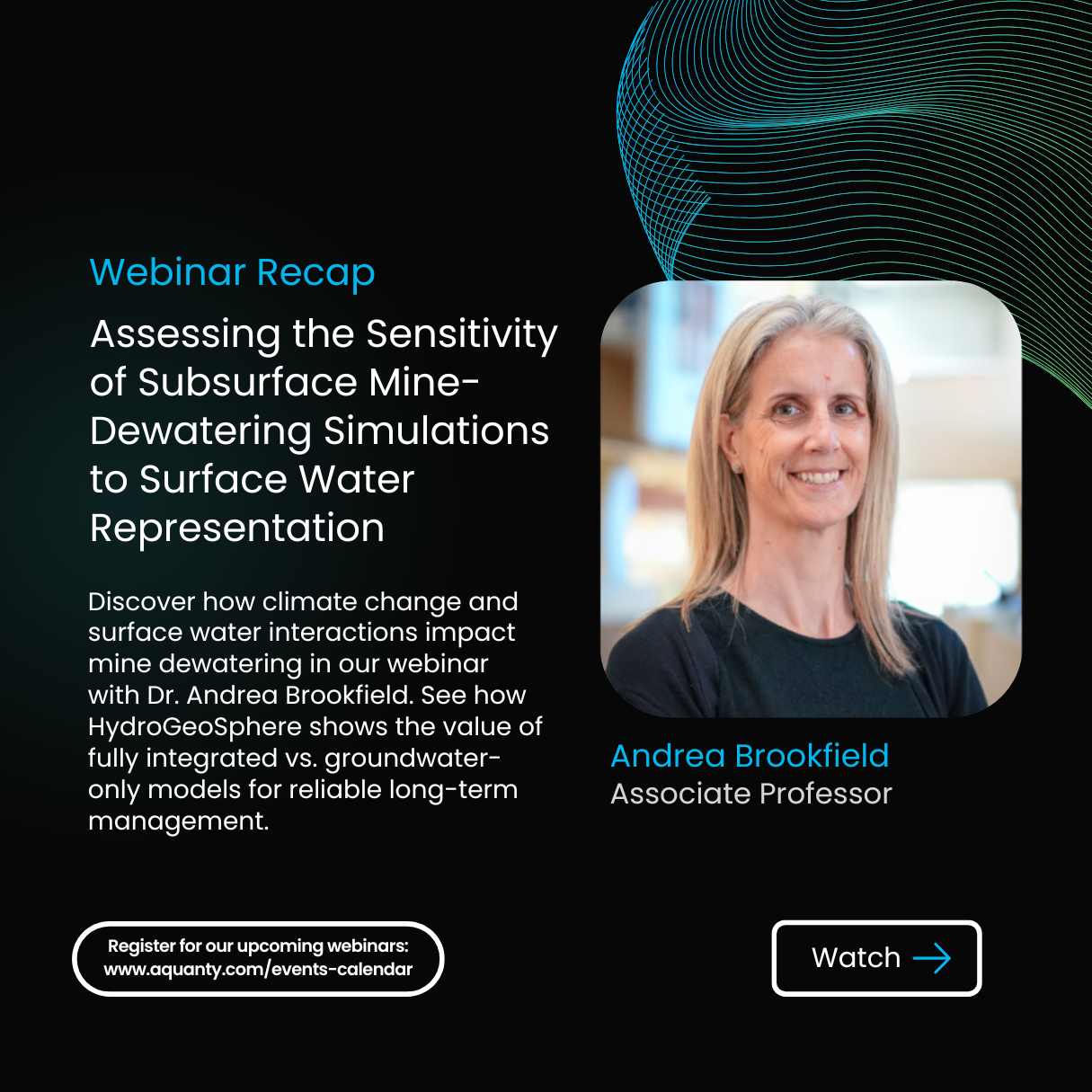
Assessing the Sensitivity of Subsurface Mine-Dewatering Simulations to Surface Water Representation - Aquanty Webinar
Explore how surface water representation shapes subsurface mine-dewatering simulations in our latest webinar with Dr. Andrea Brookfield (University of Waterloo). This session highlights how climate change and surface water interactions can significantly influence dewatering strategies across mining operations.
Using HydroGeoSphere, the webinar compares conventional groundwater-only models with fully integrated surface–subsurface simulations under future climate scenarios. The results reveal important limitations of traditional approaches and show how integrated models provide more accurate insights for long-term mine water management.
Staff Research Highlight - Steady-state density-driven flow and transport: Pseudo-transient parameter continuation
Co-authored by Aquanty’s senior scientist, Hyoun-Tae Hwang, this research presents a new numerical approach for efficiently solving steady-state density-driven flow and transport equations— an important challenge in groundwater modelling, particularly for coastal aquifers affected by seawater intrusion. The research introduces a hybrid technique called pseudo-transient parameter continuation (PTPC), which combines the robustness of pseudo-transient continuation (PTC) methods with the computational efficiency of parameter continuation (PC) strategies.

HydroSphereAI Case Study: Crowe River Near Glen Alda
In late March 2025, the Crowe Valley Conservation Authority issued a Flood Watch across the watershed in response to a forecasted storm system and ongoing spring runoff. Forecasted rainfall, saturated soils, and an above-average snowpack created the right conditions for elevated streamflows, particularly in the Crowe River watershed. With a peak spring snow water equivalent (SWE) of 149.2 mm, the basin was primed for rapid hydrologic response—culminating in a strong single peak on April 6, when flows at Water Survey of Canada hydrometric Station 02HK005 reached 45.2 m³/s.
HydroSphereAI Case Study: Sydenham River at Florence
In early April 2025, the St. Clair Region Conservation Authority issued a Flood Warning for the Sydenham River watershed, anticipating a significant rise in flows as a forecasted weather system approached the region. With much of the snowpack already depleted— leaving a modest 39.1 mm of snow water equivalent (SWE)— the primary concern was intense rainfall over already saturated ground. For the Sydenham River at Florence (Station 02GG003), this event culminated in a peak flow of 169.0 m³/s on April 4, surpassing the 2-year flood threshold of 143.3 m³/s and coming close to the 5-year return period marker of 183.7 m³/s.
Staff Research Highlight - Application of Different Weighting Schemes and Stochastic Simulations to Parameterization Processes Considering Observation Error
In this paper co-authored by Aquanty personnel, researchers explore how different weighting schemes and stochastic simulations can enhance the accuracy of parameter estimation processes, ultimately reducing uncertainty in climate change impact assessments.